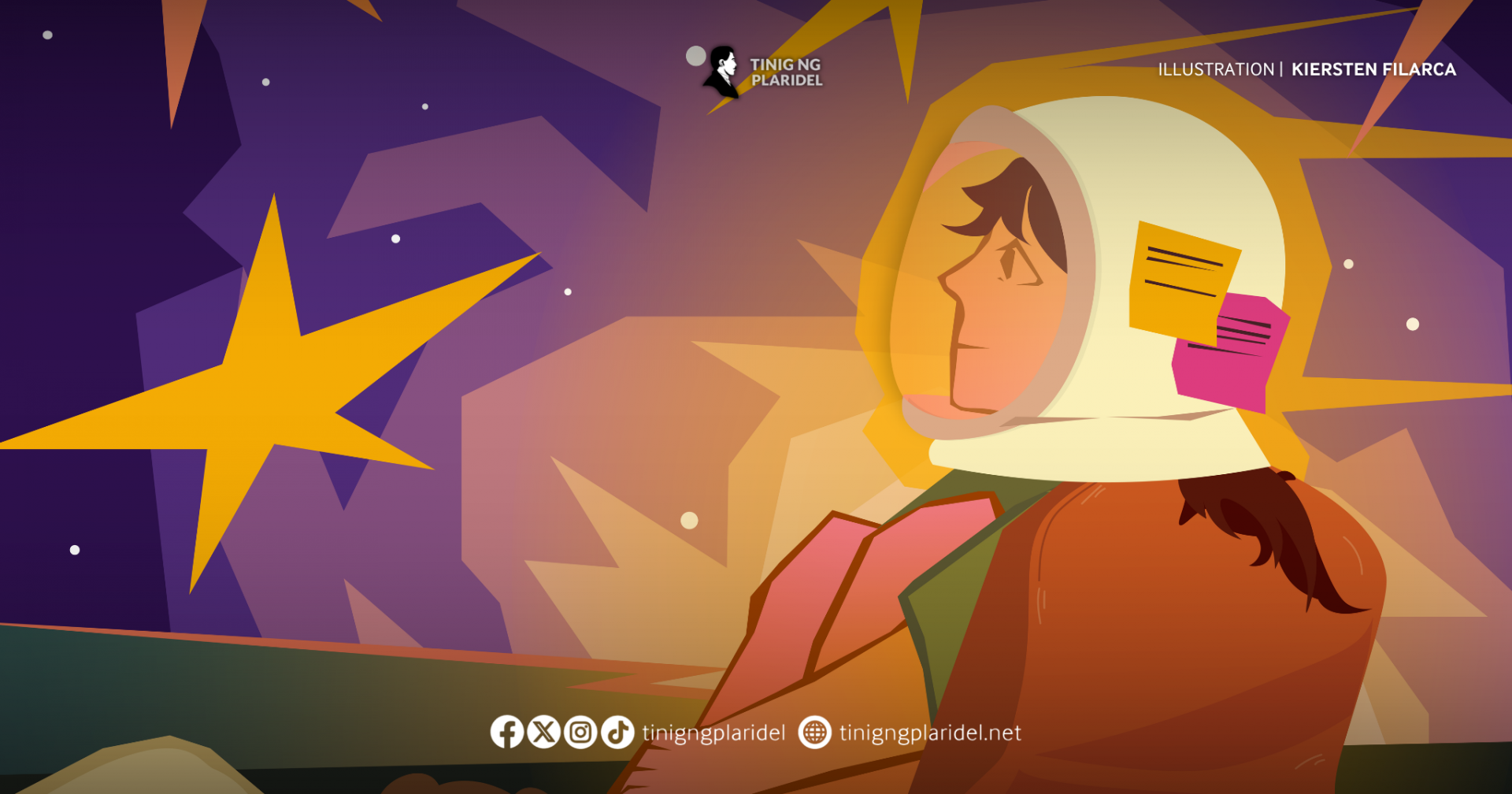
History remembers the moment a man first walked on the moon. It does not remember, however, the quieter descents. The ones that happen in cramped rooms, in borrowed spaces and on mornings when ambitious, tired bodies wake before their will does.
Every morning, I land. Not on lunar dust but on thin, cold tile floors, careful not to take up more space than I am allowed.
After hitting “snooze” for the nth time, I am jolted awake by a sharp kick from below. My roommate on the lower bunk, fed up with the cries of my alarm, has taken matters into her own hands.
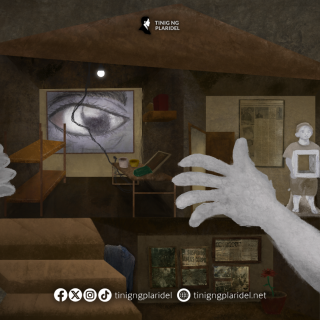
I peel my eyes open to a ceiling stained with time. The tangled electrical wires are now waving at me from these dusty jalousie windows.
The dormitories on campus were a lottery I did not win. And the high-rise condominiums along Katipunan are galaxies beyond my reach. Hence, I find myself in this almost ten-square-unit dormitory room for four in the heart of Matandang Balara.
It was the only choice left for someone whose dreams are big but whose orbits are only kept afloat by the labor of a relative working under a foreign sun.
Running on three hours of sleep, I sit up too quickly and hit my head against the low wooden frame above me. A rough landing, that is.
If Neil Armstrong had his “one small step for a man,” mine is less poetic and far more mundane. I step onto a floor threaded with snaking extension cords, my feet searching for the edge of a narrow bunk.
There is no applause waiting. No countdown, no broadcast. It is not an achievement but simply a reality etched into my decision to leave the quiet certainty of my hometown for the restless promise of the city.
Around me, the room is already alive with my crewmates performing their daily rituals. Someone fixes her hair using a palm-sized mirror while scanning notes. Another walks in from the shared restroom, hair still dripping, already late for a 7:00 a.m. class.
Inside this cramped dormitory, we orbit together like strangers bound by the same mission. Not weightless but held in place by invisible forces: dreams, fear and homesickness. We are all suspended between who we once were and who we are trying to become.
On my first night here, I lay awake, feeling like a space traveler at the edge of an endless journey.
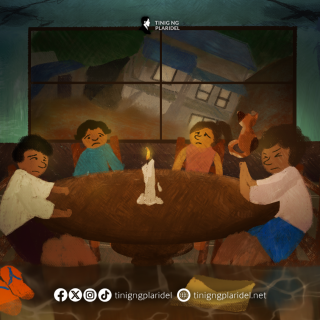
It was not the noise that kept me up but the absence of the right kind of it. No kuyas arguing over computer games past midnight. No Papa threatening that the barangay would come knocking if they did not quiet down. No cats curling at my feet, with their soft purring stitching me into sleep. No kitchen sounds hinting that morning would come with food already waiting.
Instead, silence pressed in unfamiliar and complete. Here, loneliness settles into the body until even the ribs feel like proof of how much one has learned to carry alone. In this new terrain, even comfort must be negotiated. Like a singular sun, there is only one bulb that lights the room and it belongs to no one and everyone at the same time.
Nights bend around other people’s lives — a senior whispering to herself about her draining thesis, someone laughing too softly into the phone with a “friend,” pages turning, alarms being set for futures that feel more certain than mine.
And I lie there, eyes open, wanting to ask for darkness but knowing I have no right to demand it. Morning comes anyway.
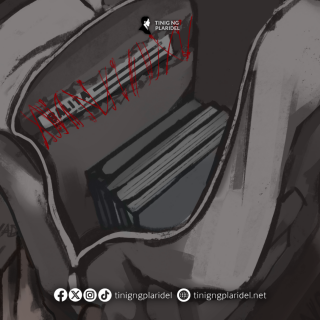
At home, meals appeared as if by magic — rice already steaming hot and sinigang waiting without my asking. Here, even food becomes a calculation measured against what I can afford and how long it must last. I live on canned goods and instant noodles, anything that can stretch both time and budget.
With the heightening commercialization around UP, the new and expensive establishments feel like glittering orbits I am not allowed to join. They seem to be a mockery to those of us who have to count every coin.
Instead, I find my fuel in the grease-slicked serving of pancit canton or a quick, salty fifty-peso Hungarian sausage and rice from nearby kiosks. On better days, when the budget allows, I seek out Jjang’s. Over a plate of a hundred-peso ramen and okonomiyaki, I am briefly convinced that I am still being looked after in this indifferent city.
Even from miles away, I can feel the pull from home. Every remittance is a tether and every “Kumain ka na?” is a lifeline thrown across the distance.
This dorm, no matter how cramped, is still a launchpad built by my parents’ hands — the same hands that packed my bags with more hope than I knew how to carry, a heavy reminder that my “one small step” is being carried on their shoulders.
Outside, the university’s concrete sprawl moves like a world already in motion, as if it had begun without checking to see if I was ready to arrive.
Everyone seems to know exactly where they are going. They walk with certainty — turning corners without hesitation, boarding ikot jeepneys at the right moment, pulling the string to signal “para” with muscle memory.
They know where to go, when to leave, whom to ask and how to exist.
I do not.
Most days, I get off at the wrong stop. I walk in slow circles, pretending I recognize the paths I take. I stand in queues, questioning if it’s even the right one. I listen in class and wonder how everyone else seems to grasp something I have not yet learned how to hold.
There are moments when the campus feels too vast, too sure of itself — and I feel like the only thing it did not prepare for.
So I return.
Back to my universe. Back to the only place where not knowing feels allowed. Inside this small, crowded room, I unfasten my imaginary helmet and loosen the weight of trying to belong. I let myself be quiet. I let myself be uncertain. I breathe again.
In a world that constantly asks me to be more than I was yesterday — where worth is measured in centavos, where success feels like something distant and glittering and reserved for people who already seem to know how to move through it all — I find myself returning here.
I am no Armstrong planting a flag on untouched ground. My steps are smaller, quieter and unrecorded in any history of discovery. I claim, at best, a kind of cosmic insignificance.
And yet I am still an astronaut of sorts. I am learning how to endure unfamiliar terrain, how to navigate vastness from within confinement, how to keep moving even when my direction feels entirely uncertain.
And maybe that is the point. Maybe being lost is not the absence of direction. Maybe it is proof that I have already left — and am still, quietly, on my way.
I close my eyes to the hum of the electric fan, no longer fighting the silence. I know that tomorrow morning, I will have to land all over again. But I am not drifting aimlessly. I am held in orbit by the quiet gravity of my parents’ love — my North Star, my tether in the dark.
As long as I can feel their pull from across the miles, the vastness outside this room does not feel quite as terrifying. I am lightyears from the life I knew, but I am learning how to survive the space in between.
This may not be the moon. But it is the farthest I have ever been from home — here, in my dormitory-sized universe.
EDITOR’S NOTE: An earlier version of this story was submitted to the Feature Writing (J 111) class of Asst. Prof. Adelle Chua.