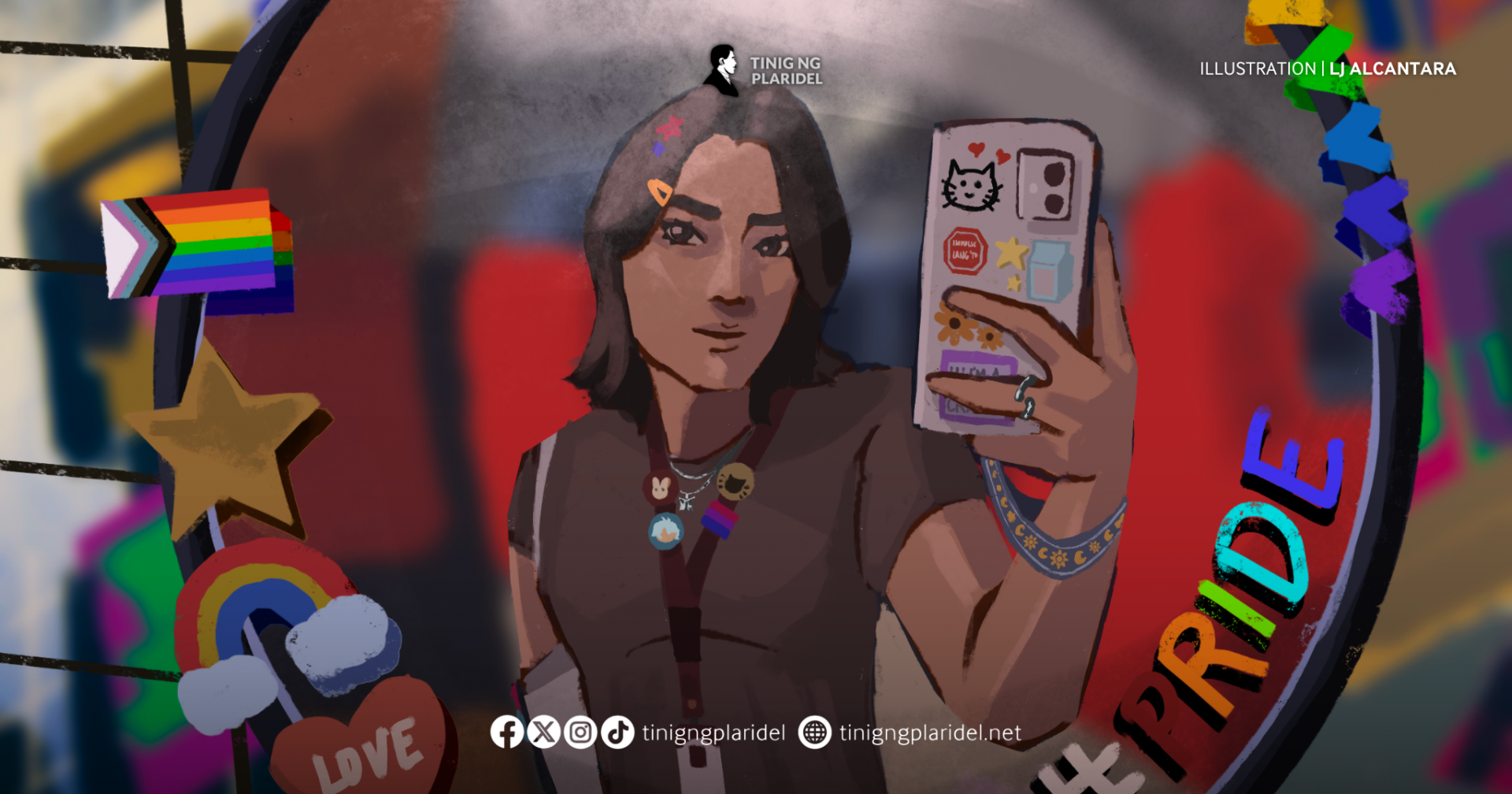
To know yourself is to recognize yourself in the world around you.
The faces of our childhood TV idols may become the characters we emulate in class, which later guide our self-discovery and define the identities we carry forward.
Yet, growing up queer in the Philippines makes this experience all the more delicate. When we anchor our identities on the media we’ve grown up with, what does it mean for those who live in a space that limits or even denies what queerness could be?
Mainstream TV channels often serve as our primary source of popular culture growing up, dictating the representation queer people internalize.
“When I think about Filipino media, there’s only a handful [of queer media] talaga. What I grew up with would be more on the love teams that everyone is used to,” Ari*, a sapphic first-year college student, said.
Today, as Filipino media broadens its portrayal of queer experiences, queer people gain more visibility in the public eye. In the vein of progressing mainstream representation, the local art community (known online as ArtPH) emerges as a new mirror of identity.
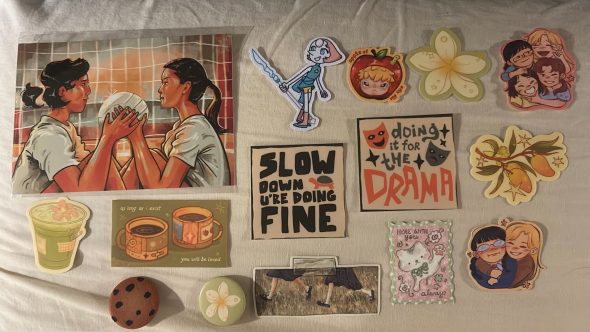 Merchandise from local artists during Komiket Pride 2026, Contributed Photo by Ari
“The very simple statement stickers or prints allow you to hold on to some form of your identity,” Ari said. “That was what really clicked for me — that I’m finally seeing my queer experience, particularly as a Filipino.”
From the shards of the heteronormative mirrors that shaped our upbringing, queer Filipinos bear the struggle of identity exploration and acceptance.
With the emergence of ArtPH, these shards are reassembled into more personal and realized pictures of queerness — reflecting it as a multi-dimensional experience inherent in its joy and ambition.
Queerness is no longer stifled because of digital art pieces, prints and stickers. It now extends to be mundanely romantic, joyful and explicit in its Filipino identity.
Shards of heteronormative mirrors
The shows, films and faces that we grew up with are fundamental to our identity, yet its widespread heteronormative mirrors restrict queer people’s right to self-discovery.
Mainstream media reflects societal norms, frequently reinforcing heteronormativity in Filipino life. This is evident in household chores, religious practices and daily interactions.
In a society that squeezes people into heteronormative margins, compulsory heterosexuality (Comphet) becomes a common experience for queer Filipinos.
“I’ve always kind of felt pressure[d] [to] have straight crushes in class. It felt [like] a requirement for me to fit in [and] to have friends,” Paolo*, a second-year college student, said, “It took me years of [being active on] social media to realize [na] bakla ako [at] asexual din ako.”
The pressure to conform to heterosexual ideals suffocates an individual internally and externally, hindering them from freely exploring their identity.
“Because you’re already in a male-centered society, it took longer to realize that this feeling of [sapphic] otherness was shared, because the default is just to assume that everyone wants a male presence in their life,” Ari said.
Comphet is not merely “adapting” social norms, but it is an act borne from the oppressive, heteronormative chains within the status quo. Mainstream reflections thereby become shards that hit queer people’s right to self-discovery.
And yet, Filipino queerness remains culturally anchored. It is an inherent joy to be queer, as seen in various broadcast movies and shows that frame queerness as boldly and authentically yours.
Classic films like “Girl, Boy, Bakla, Tomboy” (2013) depict queerness as a distinct, individual identity that is proudly and explicitly represented. The character of each quadruplet — all played by Vice Ganda — is neither diminished nor “conforming” and is instead elevated.
Jepi, a queer Filipino artist known online as Studiojepi, acknowledged this. “We all know Vice. She’s like a queer icon and ever since, she’s [been] so unapologetic. ‘Pag pinapanood ko siya, I wanted to express my inner femininity [and] queerness.”
Yet, while some mainstream stories convey the depths of the queer experience, these depictions can be limiting when queerness becomes defined by struggle.
“Alam naman natin na hindi well represented yung queer people sa [Filipino] media. [Usually] either comic relief or very tragic yung story nila,” Ivan, a queer Filipino artist known online as Ibayan, said. “Lumaki ako thinking na parang ang hirap na nga maging Filipino, pipiliin ko pa bang maging ganito?”
While mainstream representations have offered fragments of hope, many stories remain untold. To be able to see yourself represented should be an ordinary experience, not an occasional privilege.
RELATED: Sapphic affair: a love untold
Piecing the slivers of queerness
When faced with only slivers of one’s true reflection, queer people piece shards together and create their own mirrors.
For Ivan, this began with fan art of Western cartoons, which served as his first exposure to queer media.
“Alam nila kuya na very nerd ako pagdating sa cartoons,” he said. “Cartoons talaga yung parang nag-tap sa [awareness ko sa] queer[ness].”
By joining the ArtPH community, his artistic expression eventually geared closer to the Filipino experience.
“Mas nakaka-relate ako [sa ArtPH] kasi isa kami ng kultura. Isa kami na sumasakay ng jeep, isa kami na [nata-]traffic,” Ivan said.
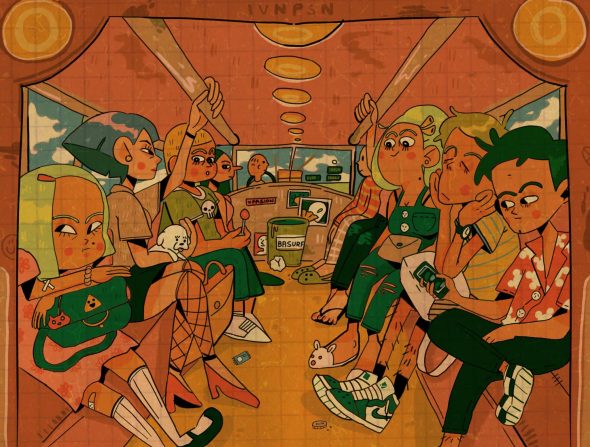
“jeepney ride”
Art by Ibayan (2020), cited from his Facebook account
Ivan said he paints the Filipino experience in warm, nostalgic tones, concurrently presenting the queer experience in vibrant color.
“May art from Ibayan with the caption ‘bebot daughter or kikay son.’ So not just romance, but [it’s also] this kind of art [that] helps me feel more confident about how I present myself, regardless of my orientation,” Paolo* said. “They make it seem so freeing and not scary.”
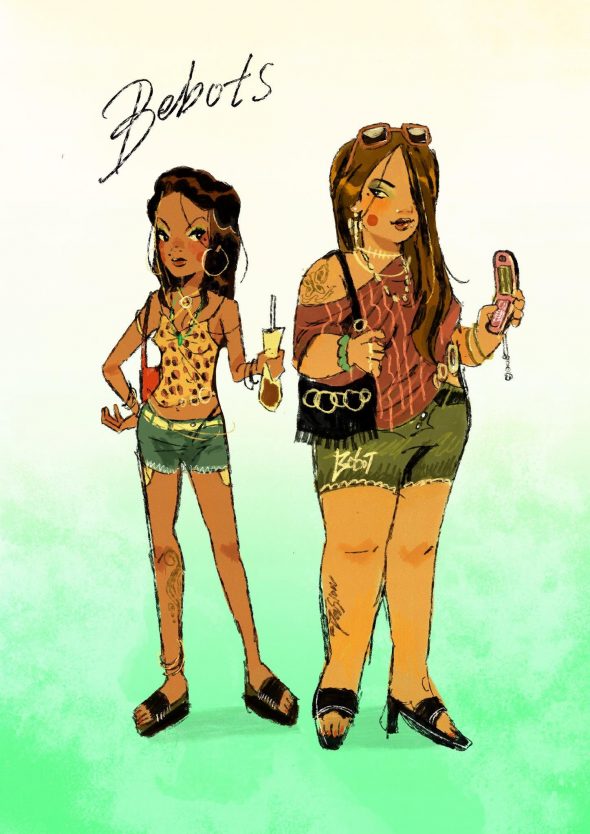
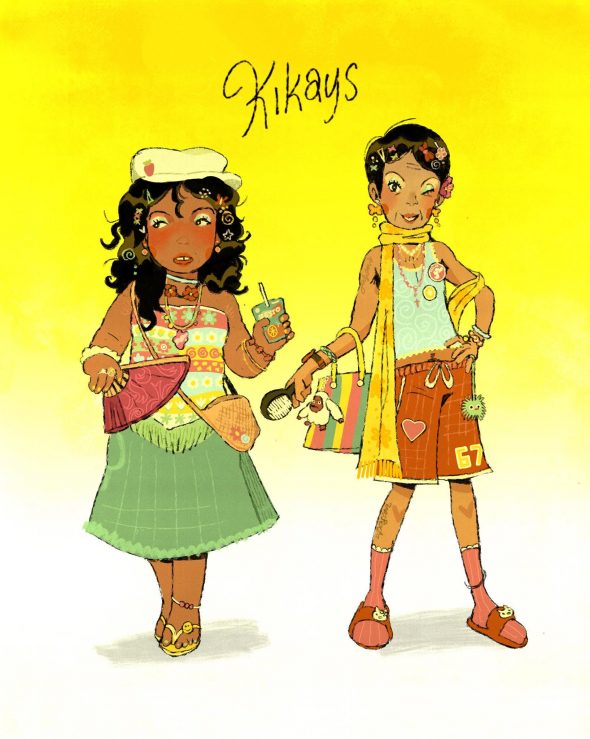
“bebot daughter or kikay son”
Art by Ibayan (2026), cited from his X (formerly Twitter) account
“Gusto kong i-drawing na being queer, the reality of life [ng] isang queer person is not easy pero pwede siya maging masaya,” Ivan said in acknowledgement of his art as a mirror for the local queer experience.
For Jepi, social media became a safe space for art to become an extension of his expression. It took inspiration from the “everyday scenes of the queer experience,” like sharing glances over a small meal between classes.
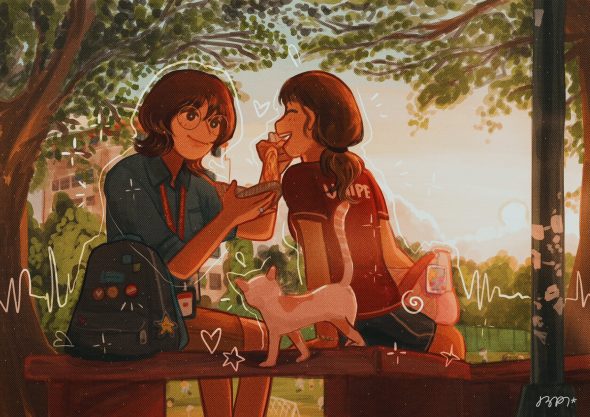
“pasukan na naman sa diliman”
Art by studiojepi (2025), cited from his Facebook account
Local queer art emerges not only as a new mirror for queer Filipinos but also as a gateway for representation that feels closer to life and basks in its mundane experiences.
“I wanted to incorporate that kind of relatability [as] a queer Filipino person into the work,” Jepi said. “I wanted people to see that they can see themselves in that piece, [that] this experience is not as bad as what other people may say about them — [that] it’s something that you can also experience as well.”
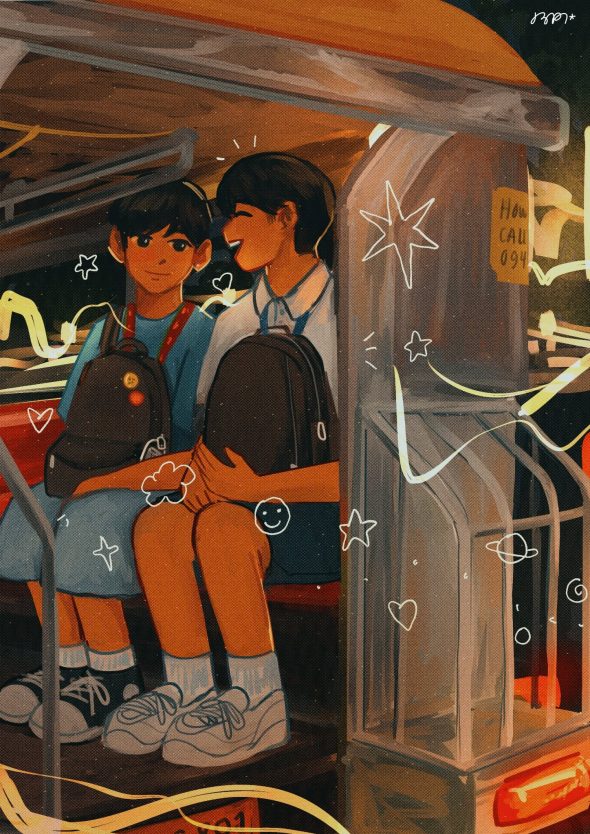
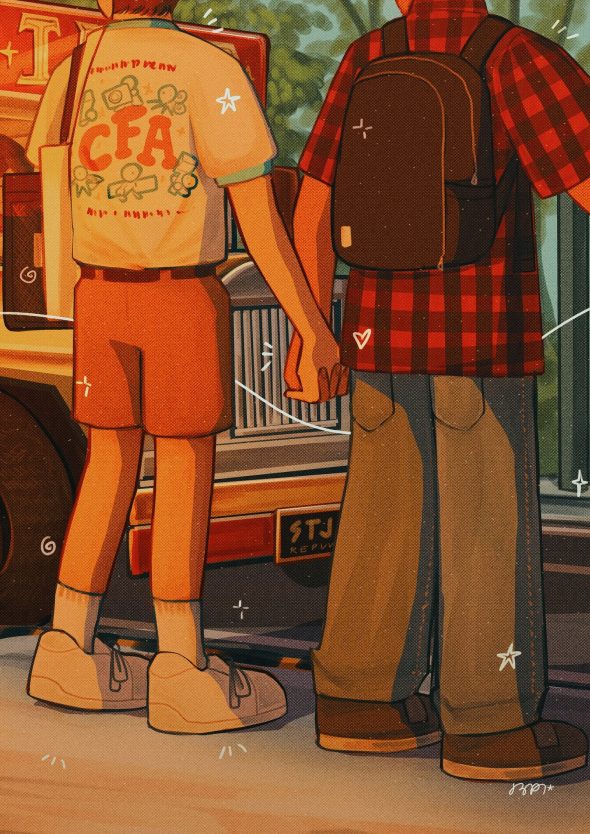
“the eyes that feast on even your most minuscule detail“ & “hintayin kita”
Art by studiojepi (2025 to 2026), cited from his Facebook account
These artworks reflect the simple acts of commuting and spending vacant periods between classes together in distinctly Filipino environments. These show that Filipino queerness, albeit laced with ambition and struggle, is also intimate and joyful.
Shared, yet personal queer experiences are finally pictured, such as elementary and high school romances framed in the familiar giddiness we encounter in Filipino romcoms.
“That very famous art print by Pandesaii — it even had the classic quintessential all-girls school uniform in the print,” Ari said. “It’s a very specific yet shared experience. I think that’s when I could confidently say it was queer art for queer Filipinos.”
With such representations, ArtPH fostered a community beyond mirrors. As growing up in otherwise heteronormative environments feels isolating, the community shows that this reality is not distant and queer people are indeed everywhere.
A prism that goes beyond
The local art scene, bit by bit, counters the heteronormative margins that trap queer people.
“This [queerness] is also as much a Filipino experience as much as it is a global one,” Ari said. “We might have the tendency to think that because we don’t see it much here, it’s like an isolated case, when it’s not.”
With the Sexual Orientation, Gender Identity, Gender Expression, and Sex Characteristics (SOGIESC) Equality Bill still yet to be passed after two decades, queer representation in media, policies and social movements becomes even more significant.
As identities may be shaped, distorted or uplifted, Filipino artists express what it means to be a queer Filipino and shine prisms on the people they reach.
“To the queer community, humayo kayo at magparami,” Jepi said. “Our wins will always be for us to hold.”
Shards that previously hit queer people’s self-image are reassembled into mirrors.
These slivers, now facing sunlight, reflect prisms — where queerness is neither one nor two colors, but a vibrant spectrum of its inherent joys and ambition.
And there are many more stories to be told.
*Editor’s note: The real name of Paolo and the full name of Ari have been withheld at the interviewees’ request.