Heated Rivalry. Red, White, and Royal Blue. Heartstopper.
Almost every year or so, there seems to be a new queer show that is taking the internet by storm.
Their narratives are slowly being pushed into the mainstream, with diverse characters and couples being introduced in Asian and Western media.
When sifting through the latest popular queer films and series, gay main couples dominate most, if not all, the posters.
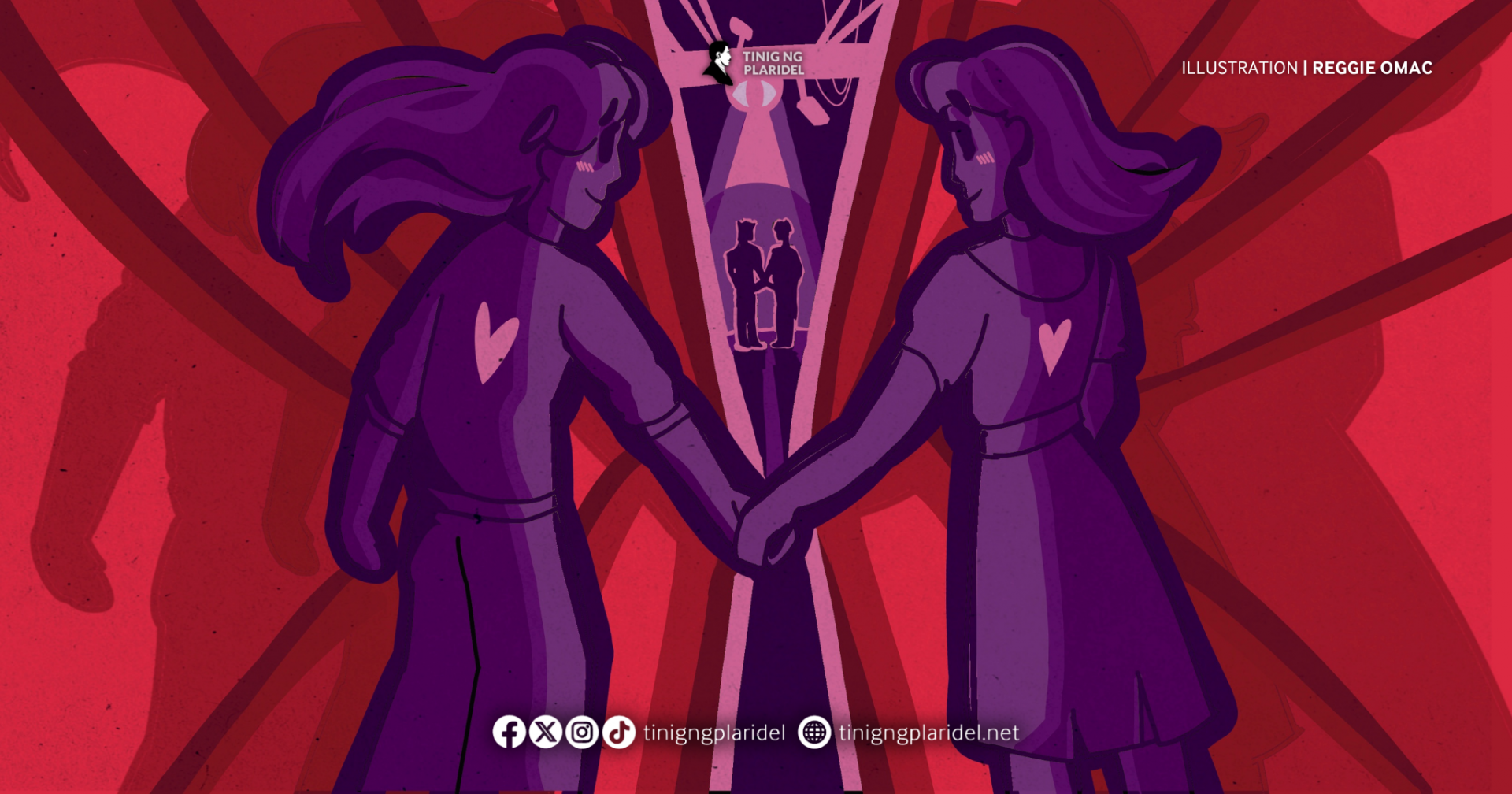
The question is: where are the sapphic representations?
“There’s much more mainstream BL (Boy’s Love) across all genres and tropes,” Carson*, an avid fan of queer films, said. “For GL (Girl’s Love), I can’t even think of any mainstream shows. They’re all fanfics that you have to look for.”
As society moves from rejecting queer experiences to tolerating and even accepting them, the queer community is supposed to gain more space to take up, breathe and be recognized in.
However, not all queer narratives or communities can bask in the same spotlight despite an existing steady stream of content.
GL narratives remain scarce or completely absent in mainstream media, in contrast to the growing popularity and interest in BL stories.
Left in the shadows
One apparent gap lies in the volume of productions between genres over recent years.
The number of BL series produced in Thailand, for example, has surged past 200 since mid-2024. This can be attributed to its long history of gay media production and the local reception of queer media.
However, there has been little production of GL media in the country, tallying only eight series on the same timeline.
Even from the start, there is already a lack of production for GL media, which may hinder its penetration into the mainstream.
“The Thai BL industry’s dominance is not really a story of queer liberation,” said Dr. Jonalou Labor, a communication researcher who studies gender and media. “It’s actually a story of commercial infrastructure.”
This is made more evident when looking into where queer media are accessible.
In a market that values production quality and premium content, audiences flock to global platforms that have successfully positioned themselves in the online streaming realm.
ClaireBell, ranked as the top GL series in 2025, can be watched on YouTube and the Thai streaming website OneD. But when compared to series available in major global streaming platforms, this does not easily translate into its popularity, reach and visibility.
Netflix, for example, has been at the forefront of the digital streaming industry with curated content sourced from professional producers and studios. Many have come to treat it as a source of “premium” content.
It has immersed itself in the production scene through its various Netflix original series and films. For GL, however, only a few were produced with lesbian couples being centered. They mostly appear as side relationships in a BL show.
“When they’re [lesbian couples] visible, they’re always the side characters,” Alex, a consumer of BL media, said.
Furthermore, GL media produced by Netflix, despite its production capacity, may still be financially constrained. A Spanish sapphic film entitled “Elisa y Marcela” is said to have been produced in black and white to not make its wardrobe and sets appear substandard, given its low budget.
As a result, GL media’s weak presence on these platforms ends up constraining their visibility.
“Mas pino-produce pa rin ito [GL] ng smaller budget. And of course, mas konti pa rin ‘yong promotional support compared sa BL,” Dr. Labor said.
On center stage
The gap between the two genres is not a reflection of audience demand but a manufactured desire to consume the other.
“Wala pang commercial formula na viable for GL because ‘yong sustained industrial investment for GL has not been established,” Labor said.
A study found that the formula built around BL are talent pipelines, fan events and product deals, allowing it to capture and keep a predominantly female audience.
GL, however, wasn’t given that same treatment. And yet, when it underperforms relative to BL, the industry reads it as a lack of demand rather than a lack of investment.
“It’s an investment problem that has been misread,” Labor said. “Audiences can’t develop [a] taste for GL and build a fanbase around GL, primarily because there’s no sustained content for GL.”
And when raw materials are not present, Dr. Labor explained, fans’ creativity is also affected because there is less material to write about and respond to.
Fan culture turns to literature, film, art or forums to express their fans’ appreciation for the media they consume.
“The AO3 (Archive of Our Own) numbers are downstream of the industrial sources or choices we’ve already seen being discussed,” Labor said, noting other media landscapes where GL content may thrive: from real-person fiction, Wattpad and television.
AO3 houses around 7 million works featuring gay relationships but only 1.4 million are published for lesbian relationships as of press time.
When queer women’s stories are treated as ‘less commercially viable’, it sends a message that goes beyond the industry. It tells queer women that their love and coming to love stories are a niche.
“Young Filipina lesbians and queer women are growing up without media mirrors, without stories that reflect their desires and relationships as normal. They would experience erasure of lesbian existence,” Labor said.
He adds that the inclusion of queer women’s narratives just for the sake of diversity or dramatization sends a message that their relationships are too special or exotic to be considered normal.
“[Nagiging] invisible din ‘yong love nila, [as if] they’re less valued, they’re less valuable and, of course, parang hindi na totoo ‘yong nararamdaman nila.”
Behind the curtains
The underrepresentation of GL in the media is not just a problem in terms of numbers and views, it’s a statement.
“The industry has become very good at a specific kind of extraction,” Labor stressed. “Kumbaga, may pagkiling na [pagkakitaan] lang natin ‘yong mga babae dito.”
BL built an empire on the backs of female audiences, yet somehow, those same women’s stories are the ones not being told.
“For straight women, you don’t really see guys like that in real life. When you see two guys who love each other like that, it feels very catered to the female gaze,” Max added.
However, Carson said that GL is more seen as a niche genre with only a selection of tropes and plots that keep the audience hooked.
Philosopher Judith Butler highlighted in Gender Trouble: Feminism and the Subversion of Identity how patriarchal structures have long governed whose desires are deemed visible and valid.
The marginalization of GL in mainstream media is a reflection of a society that has historically treated women’s inner lives, their longings, their desires and their love as secondary.
“Women are perceived as submissive. Authors or viewers in general, if you have GL, you’re going to unconsciously make the women more submissive than they should. That’s not going to be appealing to queer women. Parang male gaze pa rin siya,” Jane said.
“Patriarchy is still prevalent,” she added.
Labor supports these observations by mentioning the industry logic behind the disparity. The catering of GL to the male gaze ends up reducing it to desire turned pornographic.
Representation is never just symbolic. Scholars found that media visibility genuinely shapes how communities understand themselves and how others perceive them. This allows for empathy, normalizes diverse experiences and creates a sense of belonging and community.
In the current mainstream media, BL has demonstrated this powerfully through shows such as Heartstopper and Heated Rivalry. What began as a niche genre has grown into a cultural reset, extending queer male visibility across Southeast Asia and beyond.
A question worth sitting with is: what could the GL industry do if queer women’s stories were told with the same passion, the same production value and the same belief that there is an audience waiting?
Beyond the spotlights
The stories a society chooses to tell are never natural; they either challenge existing hierarchies or quietly uphold them.
“It’s not just the institution but the superinstitutions [that] are supportive of the heterosexual agenda. So restructuring anything that would change institutions, sadly, ‘di ‘yan susuportahan ng mainstream. So kailangan siya ng real efforts para mabago ‘yong lahat ng workings ng system from the inside,” Labor said.
With how open society is in the media, it chooses to consume and bring to the mainstream each narrative that acts as a counter-reaction to the status quo.
While the existence of queer media in general may have shone the spotlight on the marginalized LGBTQIA+ community, the fact remains that it is a community more diverse than the shows currently trending, accepted and brought into mainstream.
“Not all stories and experiences are going to be the same, so siyempre it hits closer to home when it’s actually a girl and a girl in a relationship rather than seeing you as the girl and your girlfriend in another BL ship,” Jane said.
Queer media must be able to represent the whole community it stands for. The media must be able to equally portray what the queer experience is like.
Regardless if it’s man-to-man or woman-to-woman.
*Editor’s note: Names of interviewees have been withheld at the interviewee’s request.