In a span of five seconds, a student can flip a few pages of a textbook, write their full name on a test paper or press “submit” on a research paper due that same night.
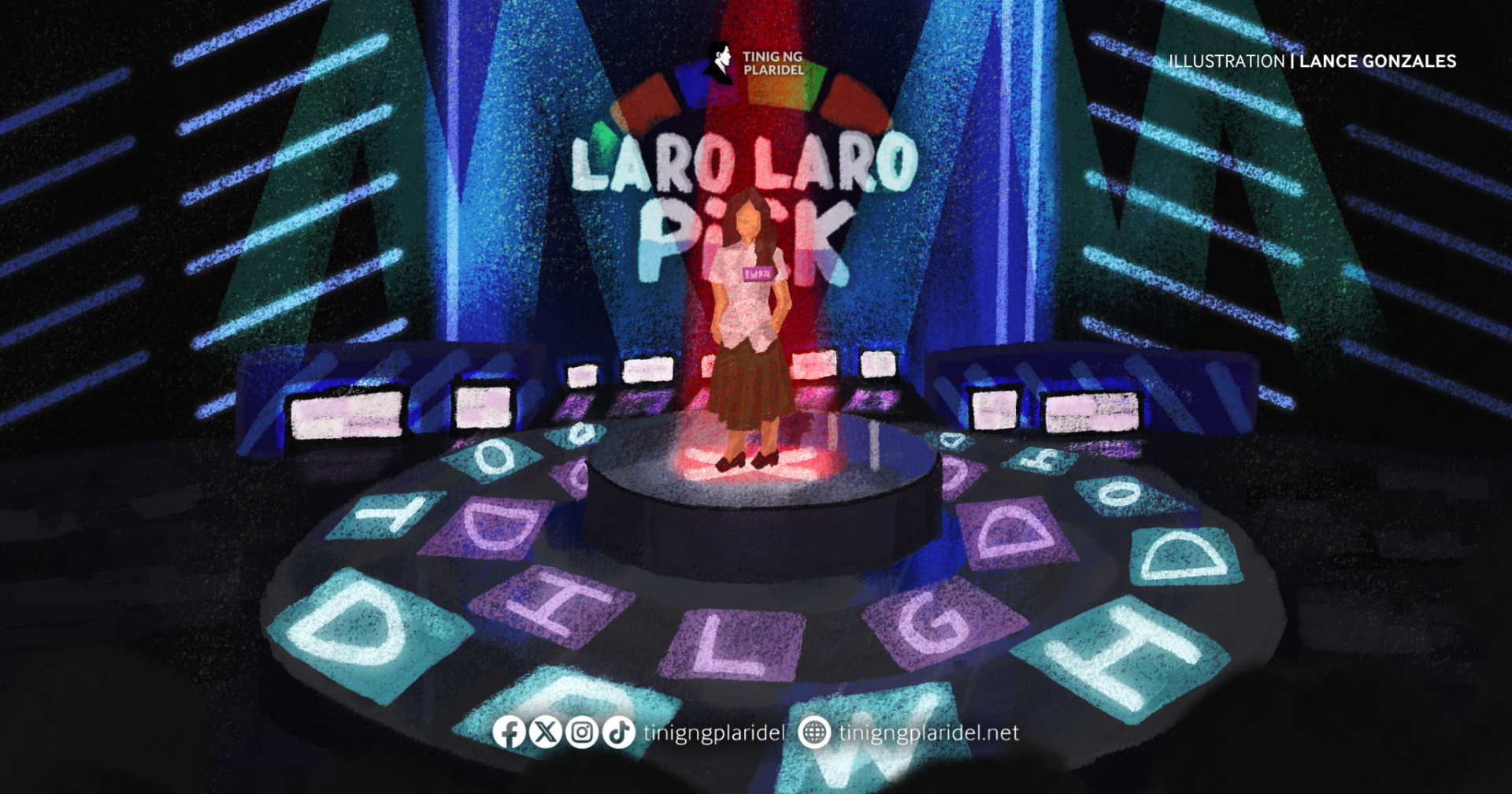
Yet, for some of the high school honor students participating in It’s Showtime’s “Laro Laro Pick”, the memorization-oriented and crisis-ridden education system made five seconds insufficient for them to name the Philippines’ executive departments.
In its March 28 episode, participants were asked in the second stage to expand acronyms like the Department of Tourism’s ‘DOT’ within the given time limit. While some had answered correctly, others either gave an incorrect answer or were unable to answer at all.
Netizens were quick to express their alarm over the Laro Laro Pick segment, sometimes directed toward the students themselves.
“Yung mga HONOR students [ay] naging DIS-HONOR STUDENTS dahil sa walang alam sa mga [sangay] ng gobyerno,” a post on X read.
With such scenes that are both educational and persistent, they hint at the learning crisis that the Philippines has long suffered under but its policymakers have been slow to address.
Under the blinding lights of the set, one truth became impossible to ignore: the Philippines’ education system is failing its students live on national television.
Now showing: educational crisis
Across four stages of mini-games, the “Laro Laro Pick” segment features its contestants competing in a last-man-standing format.
The particular stage involving the executive departments instructs contestants to answer trivia questions one by one within a five-second time limit.
Through this type of educational game, issues riddling Filipinos’ understanding of history and social studies manifest on television.
Recently, celebrity contestants on “Laro Laro Pick” failed to identify items like Noli Me Tangere characters. These celebrities came from the same program, Pinoy Big Brother, from which different contestants made rounds online in 2022 for misidentifying the historical figures GomBurZa as “MaJoHa.”
On both occasions, social media erupted with the same alarm that greeted the March 28 episode of It’s Showtime.
While online discourse can keep such issues alive, it also faces the challenge of translating virality into a deeper examination of the country’s declining education system.
When students endure and are unconsciously groomed to this system every day, alarm cannot afford to be fleeting.
Time’s up for high school AP
Prior to the implementation of the K-12 curriculum, Philippine History was the focus of Araling Panlipunan (AP) during the students’ first year of high school.
However, the Department of Education (DepEd) Order No. 20, s. 2014 shifted the AP curriculum’s focus to Asian Studies (Araling Asyano) by school year (S.Y.) 2014 to 2015, reassigning Philippine History to Grades 5 and 6 instead.
Under the K-12 Basic Education Curriculum, AP in grades 7 to 10 focused respectively on Asian studies, world history, economics and contemporary issues.
Advocates have been calling for the reinstatement of the Philippine history subject amid its gaping absence at the secondary level, even with the addition of Grades 11 and 12. However, such calls were met with DepEd’s insistence that such topics were still integrated into high school AP as contextual discussion across different grades.
Meanwhile, the New General Education Curriculum (GEC) implemented by the Commission on Higher Education (CHEd) mandated the course readings in Philippine history for all undergraduate students in the tertiary level.
For Asst. Prof. Alvin Mejorada of the University of the Philippines College of Education, this supposed integration of Philippine history is dubious due to AP’s congested curriculum and decreasing time allotment.
“Mababa na ang chance talaga na [pag-uusapan iyon],” he said. “Puwede mong sabihin na [madi-discuss] naman ang Philippines [sa ibang high school AP topics], pero do teachers actually do that, given ang dami pa nilang kailangang i-cover ta’s ang konti ng oras nila?”
Emilio Jacinto National High School AP teacher Norvin Aquerido pointed out that without a high school Philippine History subject to recap past AP lessons, students encounter multiple new lessons that ultimately do not tap into what they have previously learned.
“For example, ‘yong iba’t ibang mga [kagawaran ay] itinuturo sa Grade 4 lang. Then after noon, wala na,” he said. “‘Yong [iba nilang natutuhan, natatambakan] ng panibagong pagkatuto na hindi ginagamit ‘yong former [lessons].”
While some may consider it redundant to have a Philippine History subject throughout elementary, secondary and tertiary education, Mejorada explained that discussions are tackled more analytically and in depth as students progress in their education.
“Dadagdagan mo pa, tapos [ideally] mas mataas na yung level of thinking [ng] mga students mo,” he said.
Hope, albeit a mere flicker, sparked with the arrival of the Strengthened Senior High School (SHS) Curriculum in 2025, including ‘Pag-aaral ng Kasaysayan at Lipunang Pilipino (PKLP)’ as a core subject for Grade 11 students.
PKLP’s curriculum guide covers topics like geography and culture, colonialism, resistance movements, sustainable development and democratic processes. Following its pilot testing in S.Y. 2025 to 2026, the Strengthened SHS Curriculum eyes full implementation in S.Y. 2026 to 2027.
However, Aquerido said that even this iteration still possesses a congested curriculum.
“Dapat talaga [ang] pag-aaral ng kasaysayan ay hindi isinasama o wala nang idinadagdag pang iba [kung] gusto natin ng [malalim na] talakayan dito,” he said.
Mejorada noted that the introduction of PKLP came at the expense of the equally important core subject ‘Understanding Culture, Society and Politics.’
“While we welcome the addition of Philippine History, may inalis ka namang as important,” he said. “Kung titingnan mo overall ‘yong net effect [ng pagbabalik ng Philippine History], pagbabawas pa rin siya ng humanities and social sciences [subjects].”
In a similar vein, AP has already struggled with disparities in time allotment, Mejorada said.
“[These disparities] give a signal na itong AP — when you compare it to the languages, English, Filipino, Math and Science — ay hindi kasing-importante, [kasi] konti ang oras niya,” Mejorada added. “Ang hinihingi natin [ay] sana pantay-pantay ang mga oras.”
DepEd policy guidelines from S.Y. 2022-2023 allotted only 40 minutes of class time daily for AP for Grades 4 to 6, while other learning areas like English and Mathematics were given 50 minutes.
In the junior high school level of that same school year, AP was given 180 minutes per week, which is significantly less than the weekly allotment of 240 minutes to learning areas like English and Mathematics.
While the new MATATAG curriculum sees the aforementioned learning areas with equal time allotments, Mejorada viewed this as a “wait-and-see” situation.
As the country continues to navigate a learning crisis, every learner is undoubtedly affected across all learning areas. Even as the crisis focuses “more [on] literacy,” as Mejorada described, its contributing factors like classroom congestion, also bleed onto AP.
Troubles not found in textbooks
Despite being identified as the lowest level of learning, memorization has unfortunately become Filipino educators’ means of compromise. This is especially true for subjects like history and social studies, where students drown in numerous names and dates quarter after quarter.
Mejorada said large class sizes across the country rely on memorization because more critical assessment types are too demanding amidst limitations on resources and time.
According to DepEd, the average class size was 50 students per class and the maximum was 65. These values are higher than what Mejorada described as a “manageable” range of 25 to 30 students per class.
Assessments like essay questions, when administered to a class of 60 students, would take more time to check than memorization-based questions, according to Mejorada.
Despite its prevalence, however, memorization as a studying technique proves futile due to AP’s aforementioned congested curriculum.
As Mejorada elaborated, students entering a new quarter will “naturally forget” what they had memorized in the previous quarter because they are required to memorize another set of information — especially if lessons between quarters are not connected.
Giving AP more time and resources will better equip teachers to properly conduct more enriching class activities like balitaan, he also said.
“[Kung] hindi ka bibigyan ng time, leeway, flexibility ng curriculum to really discuss that [DPWH issues], [mababaw] lang mababanggit [in] the classroom,” he said.
Additional time for AP would enable teachers to move past memorization as a tool for learning retention. According to Mejorada, assigning more thorough projects on how these departments work helps students retain the topic by applying their critical analysis.
“Para maging memorable ang mga bagay, kailangan nating i-tap yung higher-order thinking,” Mejorada said.
Proposals for personal engagement
The aspect of memorability carries more weight when even students themselves perceive subjects like history and AP as uninteresting. For Aquerido, this perception stems from students’ inability to relate to past events.
“Iniuugnay [ko] ‘yong bahagi natin ng kasaysayan sa kasalukuyan nating panahon,” he shared. “Hindi nila naisip na ‘yong kada action [noon] ay may resulta [kung] bakit tayo ganito ngayon at paano natin maiiwasan ‘yon sa hinaharap.”
A 2024 study showed that student-centered activities like dramatizations, field trips, and debates also improve students’ interest and performance in Philippine History, especially as these allow them to personally relate to lessons.
Teachers’ Dignity Coalition National Chairperson Benjo Basas said that students must also be encouraged to personally evaluate the country’s history.
“[Ipakita] natin sa ating mga mag-aaral na kinakailangan[g] tumitingin tayo sa kasaysayan,” he said.
As audiences await the next “Laro Laro Pick” episode, wary of which educational shortcoming will be exposed next, they must also look behind the scenes and see who is pulling the strings of the country’s education systems.
Come the next five-second countdown, the microphone now pivots to those powerful few for their long-overdue response – not to the calls to improve students’ memorization skills, but to create an education system that will encourage students to go off-script.