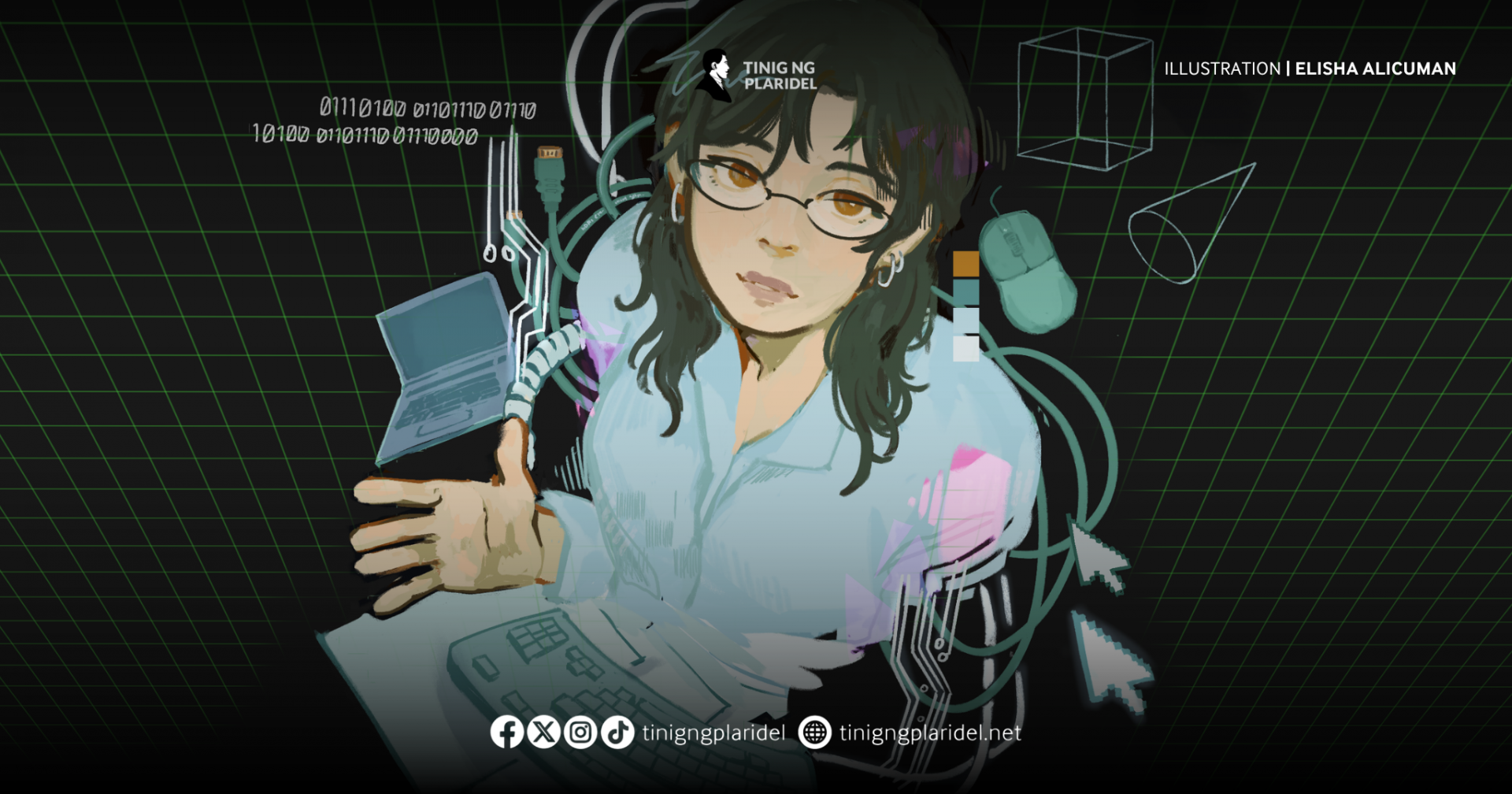
Marie Quitoriano recalled a photo her mom once took of her as a young girl, sound asleep while holding her Science textbook close.
She recalled this as one early memory of her interest in the Science, Technology, Engineering and Mathematics (STEM) field, which eventually took root and continued to grow with her.
Now in her final year as a BS Computer Engineering student in University of the Philippines (UP) Diliman, Quitoriano’s love for STEM was troubled with challenges that the system has unjustly imposed.
According to the United Nations Educational, Scientific and Cultural Organization (UNESCO), gender stereotypes, lack of female role models and discouragement from family, school or the media are the top reasons that discourage young women from pursuing STEM.
Despite studying in a university that call for equality and diversity, Quitoriano have not escaped the chokehold of the patriarchal system that plagued her four-year journey in the program.
In UP Diliman, there remains a huge disparity between men and women in some STEM-related programs.
Only five of the 31 regular faculty members are women within the Electrical and Electronic Engineering Institute, where the department of Computer Engineering is under. Meanwhile, Quitoriano described the lack of female peers as an isolating experience and a complete 180-degree turn, especially for someone who graduated from an all-girls school.
She recalled times when her male peers would refuse to accept corrections she would make on their work.
“[T]hey’ll [male friends ]only agree with my answer once another guy steps in,” she said. This has led her self-doubt sometimes to question her abilities in both rejection and success.
“I have this weird mindset na ‘Oh it’s because I’m a girl na I didn’t get this’ or ‘It’s because I’m a girl that I did get this’ like a diversity hire,” she said.
Such encounters serve as a strain women have to endure in the field, one that their male counterparts would never have to go through at universities.
Data from the Philippine Business Coalition for Women Empowerment showed that only 46% of women are more likely to study STEM at universities
To those who chose to continue studying this discipline, the same problems follow them well into their pursuit in the field. UNESCO revealed in 2024 that only 35% of STEM graduates globally are women.
Late start to STEM
For Jamina Eclarin, a 3rd year BS Computer Engineering student, working on computers was not her initial choice despite her interest in technology and gaming.
She planned to take up medicine, something she was led to believe was the more ‘conventional’ choice for women. Her family envisioned her in a white coat career, while her older brother was expected to take computer science.
“Kasi usually ang expectation [ay] mag-nurse. [O] kung hindi nurse, doktor,” she explained. “‘Di naman outright [na] pinagbawalan ako na mag-computer engineering, pero it was implied na ‘yong kuya ko [‘yong] magko-computer science.”
Among the reasons she pointed out why women do not take up or are late in undertaking the field was the unsaid yet lingering expectation that women should not pursue STEM.
Even at an early age, a woman’s social environment and educational upbringing have already started to set the standards of what women can and can’t be.
Although women are overachievers in math and science subjects, Eclarin said that it rarely translates into actual careers in STEM.
Continuing inequality, structural shortcomings
As computer engineering students, both Quitoriano and Eclarin have observed the uneven ratio of men and women among students and the faculty.
“Halimbawa, sa [laboratory] class last semester, bente kami [in total]. Hulaan mo kung ilan lang ang babae. Dalawa [at] kasama na ‘ko doon,” Eclarin said.
“I only had my first female professor when I was [in] second year, second sem[ester],” she added.
Rooted in this disparity are discrimination and sexism, which Eclarin witnessed firsthand the offhand sexist comments and jokes that her male peers have made in class.
“Yung mga peers ko, I’ve had somebody say ‘Hindi mo mapagkakatiwalaan ang babaeng engineer na gumawa ng tulay kasi [may] period sila and [when] they’re on their period, baka mali yung kwenta nila,” she said.
“I’ve had people say, ‘Wouldn’t it be weird kung may babaeng astronaut kasi if they wore a dress makikita ng mundo from below?” she added.
The same holds true for male professors in Eclarin’s department. “One of the teachers that I’ve met said, ‘Oh I don’t like feminism, I don’t agree with feminism.’”
The toxicity of patriarchy have spread widely not just in individual mindsets but also the very system itself. Within the university, women remain at a disadvantage in STEM education.
Eclarin recalled experiencing a bad case of dysmenorrhea on the day of an exam she was not allowed to skip or retake. This forced her to choose between taking painkillers, which she feels would slow her brain down, or pushing through the pain without any medical intervention.
Exams in her college would usually take place at night and can end as late as 9 p.m. – raising safety concerns.
Through the seemingly inconsequential policies of prohibiting the retaking of exams and late-night exam schedules, inequality against women continues to foster at institutional levels — even more so when institutions offer no support for women.
For Celeste*, a student from the College of Science (CS), her department is more conservative than other institutes in their college. This conservatism manifests through inadequate accommodations and arrangements for gender inclusions.
As a trans woman, Celeste opted to register a lived name in her CRS student profile. However, she finds that many of her professors either fail or refuse to observe her choice. With no clear guidelines on these matters, she is forced to repeatedly clarify her lived name in almost every class.
This bleeds into the lack of consideration for women. Celeste said that it was not until recently that a gender council was established in her institute. Sexual harassment cases within their program could only be previously dealt with at a university level.
“It feels like things are getting better, but they only recently got better and they’re not getting better very quickly,” Celeste added.
Filling the gender gap in STEM
Celeste said that having more women become educators bridges the gap between the number of male and female faculty and would encourage more young women to do the same.
“I think it really starts in high school [and] grade school. Get people to be more comfortable in entering male-dominated fields,” Marie said.
STEM continues to hold a certain prestige in the eyes of most people. Eclarin described a phenomenon throughout history where male-dominated fields are deemed difficult but begin to lose their reputation once women start breaking into them.
The exclusivity and honor STEM holds today is a manifestation of the validation patriarchy gives to the field. Its structure and systems continue to, whether unknowingly or deliberately, gatekeep the field from women.
Discrimination against women remains normalized, their abilities are questioned and their interest in the field is discouraged.
In a field widely perceived to be a man’s world, many women like Quitoriano, Eclarin, and Celeste continue to carve out spaces for themselves in STEM. Beneath these tales of triumph are stories of dreams fulfilled, struggles endured and a continued search for belongingness in a world that continues to define and limit their roles.
Despite this, women’s strength still shines through. They remain unwavering in their fight to create spaces for themselves with the goal that, finally, they can be center frame in the snapshots of STEM.
“I understand that there is a lack [of representation], so I’m trying to fill that gap — hopefully,” Quitoriano said.
Editors’ note: Celeste’s real name has been withheld at the interviewee’s request.