It was noon when the foot traffic of students in Area 2 became more and more predictable. With class finished for the morning and others preparing for classes afterwards, many students flock to the area to get their replenishments for the day.
One would ordinarily just look for a vacant carinderia, eat their lunch, rest for a moment then go prepare for their next class.
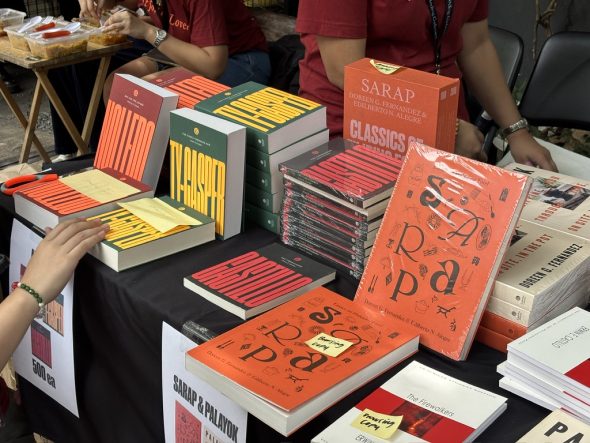
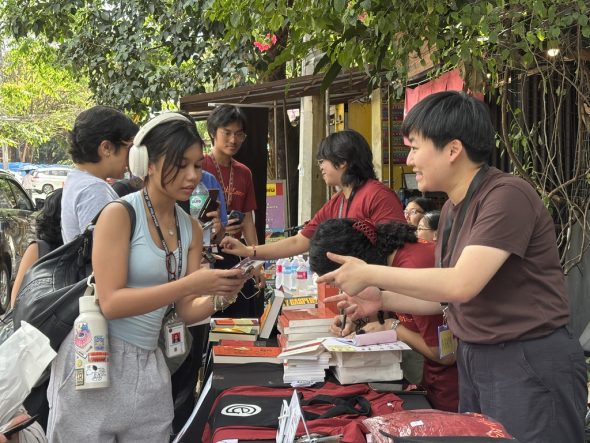
But those who were in the vicinity on Feb. 6 got to see a curious group of people wearing maroon with a statement “But for the Lovers” written in orange on their chest.
One rather vocal member from the group, with a large paper attached to their ID lace exclaimed what was written to the observers: “Book sale! Student prices!”
Among the ebb and flow of these students, it was fortunate that some had witnessed what all the fuss was about.
Erin, a Bachelor of Library and Information Science student, was in this same position: she was looking to get a quick caffeine fix before she wound up at this rather intriguing pop-up of books she’d never seen before. There laid a stack of books whose design caught everyone’s eyes by surprise.
It was her and a couple of onlookers on a clear, chilly February afternoon who looked for one thing and got another — a roster of books so deftly and confidently designed you would only assume they came from a best-selling author.
Who would have thought to put the authors’ names in bold as the main visual design, all the while remodeling the usual dimensions we usually found our books in?
These elegant, boxy, inspired works come from a small independent press known as Exploding Galaxies. And what they specialize in is even more special — republishing the lost works of Philippine literature.
Since its establishment in 2023, Exploding Galaxies has (re)published five literary works: three novels and two food books.
Its latest releases, Sarap and Palayok, contain great illustrations of practices and rituals of Filipinos surrounding food, supplemented by essays that provide immersive cultural and contextual backgrounds to each displayed dish by Tikim author, Doreen Fernandez.
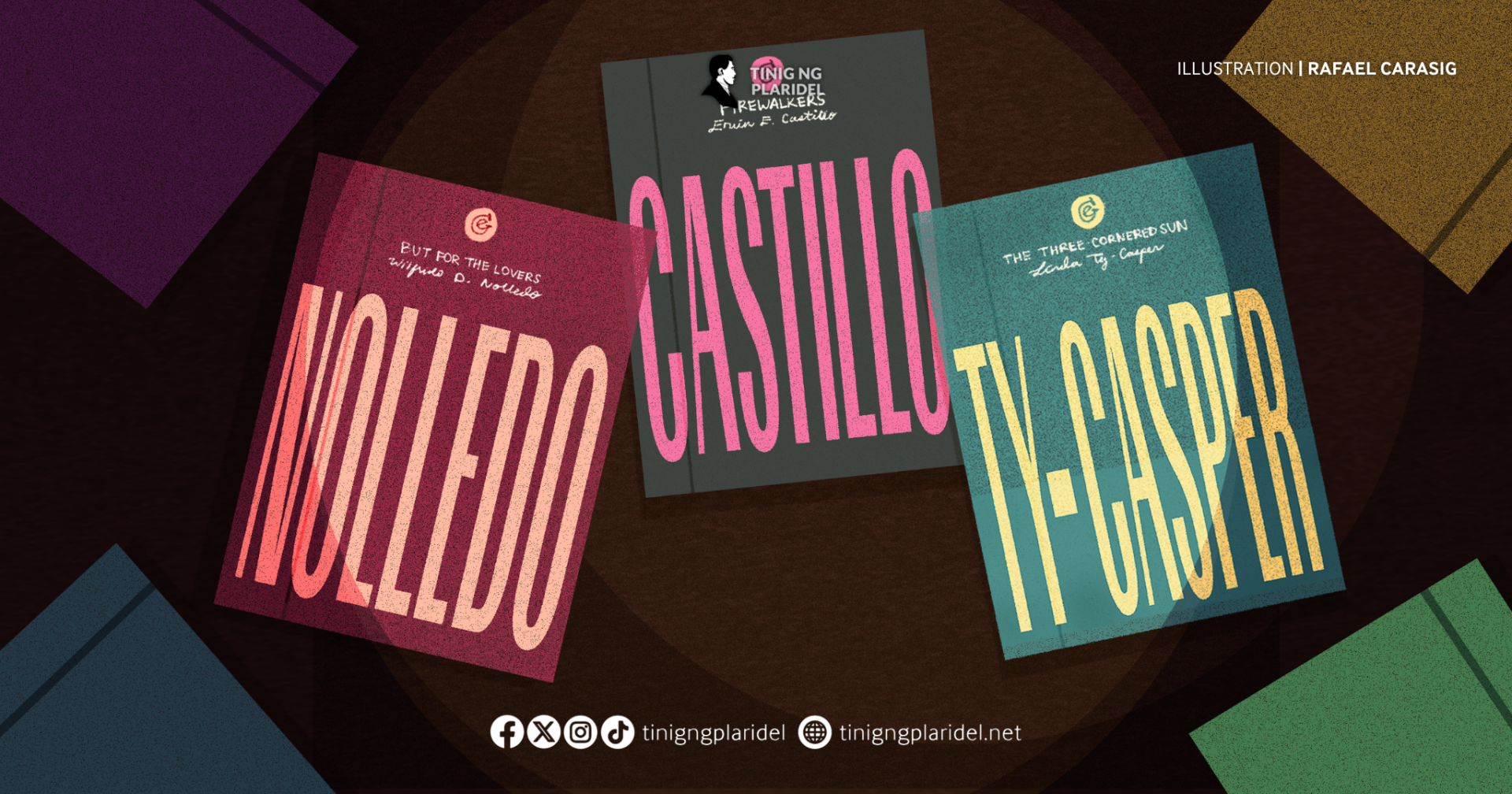
In terms of its fiction catalog, its latest is Erwin Castillo’s The Firewalkers, a historical fiction set years after the Philippine-American War. It features a police sergeant “keeping the peace” amidst the threat of a monster feasting on children’s corpses in a Cavite mountain town.
The Three-Cornered Sun by Linda Ty-Casper, alternatively, tells the story of a family’s conflicting experience of the 1896 Philippine Revolution.
Meanwhile, Wilfrido Nolledo’s But for the Lovers envisages the “liberated” image of post-WWII Manila. This was later deemed by foremost Filipino literary scholars like Caroline Hau and Gina Apostol to be, in Apostol’s words, “sui generis”.
A tasteful revival
According to Exploding Galaxies publisher Mara Coson, their endeavor to restore these texts was born from the fact that many of the best works in Philippine literature were hard to find. It also helped that many people, like the team, were also trying to look for these same books.
Case in point: their first book, But for the Lovers, had neither a Philippine edition nor a wide circulation of the original book for over 50 years since it was published in the United States, Coson said.
“The Nolledo family trusted us with this book and without them, not only would we not have been able to start, we wouldn’t have been able to launch the press with what I believe is one of our greatest works of Philippine literature ever written,” she said.
It is because of their restoration of “lost” Filipino books that bookish individuals could not only remember these great Filipino authors but also be entranced in the worlds found in texts we thought had been gone.
“We want each title we republish to be easily accessible from here on: in bookstores and in libraries,” Coson added.
Another anecdote said that there were “only ten or so remaining copies” left in the publisher’s office for The Three-Cornered Sun, with no plans of republication. Exploding Galaxies’ republication had prevented an otherwise tragic loss of one of the best Filipina writers in her generation, Linda Ty-Casper.
Still, Coson admits that they cannot republish all the works in their “wish list.”
“Sometimes titles drop off our wish list for various reasons: from not being able to find the authors or the stories themselves, to the different levels of limbo books fall into at no fault of the works or the authors who are often long gone,” she lamented.
Regardless, to be actively involved in the return of books thought long gone is a significant feat.
The devil is in the details
One aspect that attracts many readers to Exploding Galaxies is its insistence on making these works look special.
This is something that the entire team takes pride in: the fact that their covers are instantly recognizable because of their design.
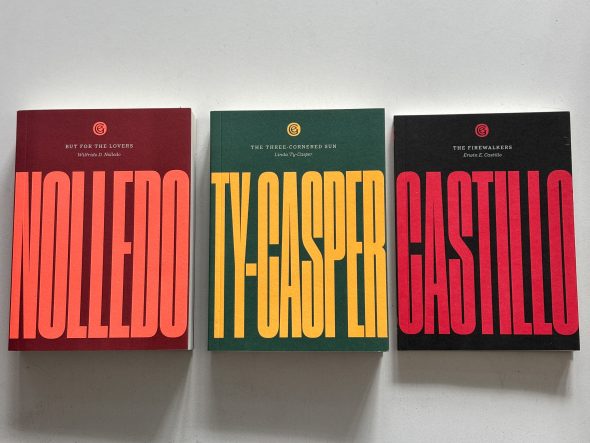
That physicality is intended for further recall. “If you want to take forgotten authors back to the forefront, you want to do it physically,” according to Mika Soria, a publishing assistant at Exploding Galaxies. “Because you want to feel the book in your hand, you want to feel and read what the writers wrote.”
These design elements are important not only for satisfying the readers but also for honoring those who have given the team permission to republish said books.
As Coson said, “We wanted to give it the care that we could because we know that for an author, the feeling of being in print is special and that reading in print can be for a reader too.
“We wanted to make sure that the care entrusted to us by the author and their estates is reflected in the book as well, and also by readers who give this book their days and hours,” Coson emphasized.
While the Exploding Galaxies team puts a premium on the physical experience, Coson also mentioned their plans to release digital copies “to improve geographic accessibility.”
Being on the same page
For Soria, their catalog contains some of the most prolific Filipino writers of their time. However, their work remains obscured by a multitude of reasons, like the lack of proper archival.
“We don’t [know] a lot of these books unless you have a whole major about it. And even from that curriculum, I rarely heard about [Wilfrido] Nolledo and Linda Ty-Casper,” she said.
A graduate of creative writing herself, Soria fostered a love for Philippine literature through their degree. But they understood that this was not a position many others could share.
“I knew a lot about Philippine literature before, but I think the more I read in the curriculum — the books that we had — the more I appreciated it and I realized that, ayun nga, we don’t have access [to older Philippine literature],” Soria said.
For both Erin and Soria, the appeal of Exploding Galaxies rested on the fact that they saw something different and refreshing.
“I admit I haven’t been reading a lot of Philippine literature lately, so the fact that I found something related to Philippine food specifically, na-enganyo ako. Because I don’t think I’ve ever seen a book on that before,” Erin said.
Curating our lost literature
With their latest releases Sarap and Palayok spotlighting food, the publishing house evidently does not have a strict obedience to theme in what they publish. According to Coson, this is because sometimes “the right title comes to us at the right moment.”
“At first, we wanted to only republish novels, but we ended up doing short stories, then now, food books,” Coson said. This varied nature ensures that every one of their releases is special.
Many people had contacted the press because they were looking for Fernandez’s books before. So for Coson and the team, it was a no-brainer to “expand laterally into food writing.”
“Doing that has only strengthened our mission of rediscovering them,” Coson said.
Readers can expect many releases from Exploding Galaxies this year. They will be releasing its annual print anthology called e.g. in March and a collection of Nolledo’s short stories in April, focusing on stories he wrote ten years before the release of But for the Lovers.
For those who have a title they want the press to (re)publish, Coson said they enjoy receiving such requests from their readers.
Turning a new page
For people like Coson and Soria, the press has been a culmination of tireless effort throughout the years.
For people like Erin who have yet to discover the works that Exploding Galaxies republishes, the mere sight of their books is as if one has stumbled into a gold mine.
A single glance at their catalog is all you need to see the care it took to make the press happen. And, if possible, to lend an ear and listen to their stories — of how Exploding Galaxies made it possible for these books to have new lives.
The Philippine literary space is a vibrant one. One need only know where to look.