Today, a stray cat enjoys more freedoms than two million Palestinians in Gaza.
A stray cat can roam around the streets without fear of getting bombed. Palestinians cannot.
A stray cat can seek food without waiting in chaotic queues. Palestinians cannot.
A stray cat can sleep soundly with its kittens without being targeted. Palestinians cannot.
A stray cat enjoys freedom. Palestinians cannot.
Statistics bombard people left and right just as much as artillery does on the battlefield. And when data fail to carry the weight of war, the people turn to art. What we fail to comprehend in numbers, we feel through art.
Such is precisely what “The HeART of Gaza: Children’s Art From The Genocide” exhibit seeks to accomplish as it opens its doors to the Filipino public from Oct. 4 until Nov. 5.
Two years since Israel’s all-out attacks on Gaza, 90% of the population has been displaced as casualties continue to rise. Over 66,000 Palestinians have been killed. Almost 169,000 have been injured. Among the death toll, more than 20,000 were children, with 1,009 being under age one.
Using simple math, one can conclude that at least one Palestinian child is killed in Gaza per hour.
RELATED: Razing Generations: US-Funded Israeli Genocide Rages in Gaza
Peeking through the lens of a child, “The HeART of Gaza: Children’s Art from the Genocide” project offers a unique view of the disturbing situation in Gaza through drawings.
The project was born from the joint efforts of artists Mohammed Timraz and Féile Butler, showcasing artworks from children who witnessed the horrors of the war firsthand. As a travelling exhibit, the HeART of Gaza has toured different parts of Europe and recently made its way to the Philippines.
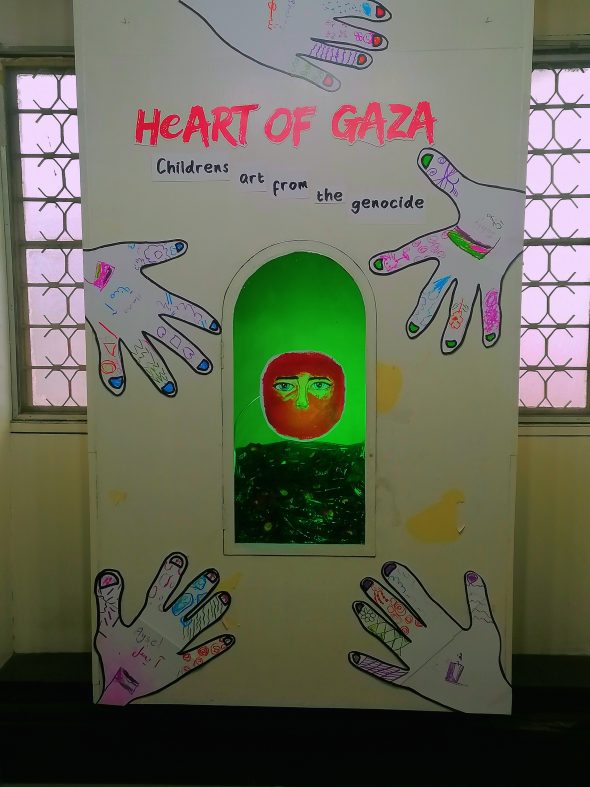
With the help of Gantala Press, the exhibit opened in Chapterhouse in Sikatuna Village, Quezon City, centering on providing context and statistics of the ongoing genocide, as well as expressing solidarity with the Palestinian plight.
Gantala Press publisher Faye Cura is honored as the exhibit is brought to the Philippines. But holding the exhibit carries another responsibility with it, alongside depicting the Palestinian struggle.
As Gantala Press boycotts the Frankfurt Book Fair, the world’s largest book fair, where Israeli and German powers exclude Palestinian narratives, the exhibit becomes an opportunity to document rich yet dreadful Palestinian narratives.
For Cura, holding the HeART of Gaza is a balancing act against the exclusion of the Palestinian struggle.
“Philippines ang guest of honor sa Frankfurt Book Fair, so tama lang na Philippines din ‘yong magdadala ng narratives on Palestine as an act of solidarity at bilang pangontra rin sa narrative na binubuo ng dominant powers [Israel] na manaig,” Cura said.
For a country that has recognized the State of Palestine since 1989, the Filipino masses’ views on the plight of the Palestinians remain divided primarily because of religion. The HeART of Gaza exhibit hopes to educate Filipinos about the destructive nature of genocide on the lives and dreams, specifically of Palestinian children.
Barbarity Eternalized
Right now, while a stray cat can easily search for new homes when displaced, Palestinians cannot. With 83% of Gaza’s structures destroyed, its citizens can only wander in dusty open air, amid the threat of bombings and air raids, in search of fleeting safety.
As visitors make their way up the stairs, a time capsule narrating the history of escalating Israeli aggression on Palestinian soil since 1946 can be seen on the walls of the exhibit’s second floor.
Drawings of the physical and emotional toll of the genocide await attendees, like children eager to tell their stories. Exhibit labels are found next to each artwork, providing context and updates on the child artist’s current status amid the genocide.
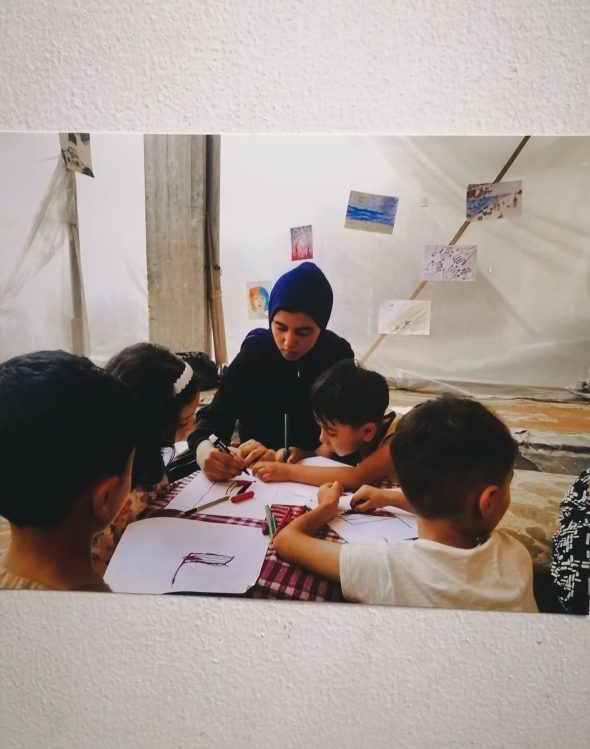
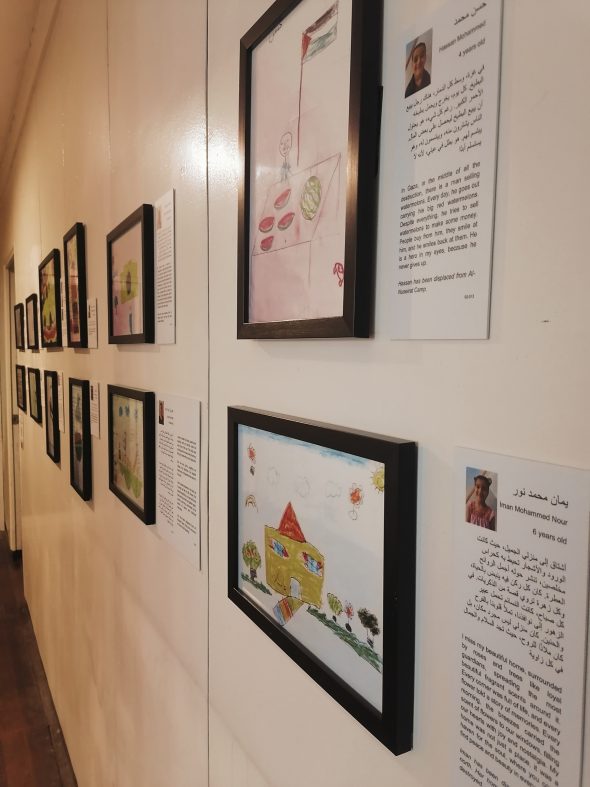
Form-wise, what one expects from drawings of children is expressions of their dreams, ideas, and joys. However, in the exhibit, the sheer barbarity of the Israelis is both eternalized and exposed.
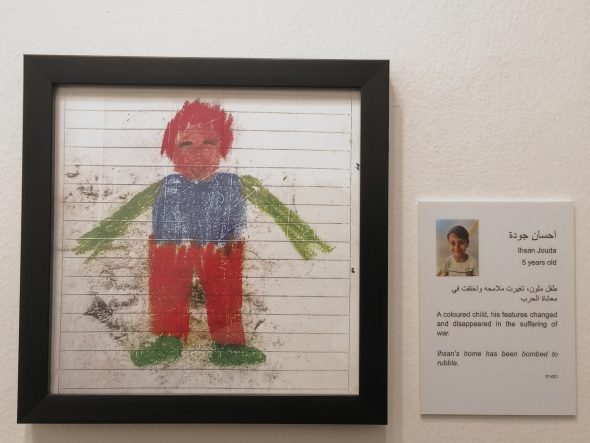
An artwork by 5-year-old Ihsan Jouda focuses on the physical toll of the genocide, featuring a child whose appearance significantly changed throughout the war.
The physical toll of the genocide has made itself apparent among the population. Palestinians are deprived of even the most basic food necessities. As of October 1, 2025, deaths caused by malnutrition have climbed to 455, with 151 of these deaths being children. Even baby formulas were prohibited from being distributed in Gaza.
Trauma and grief are two predominant themes in many of the artworks. These feelings transcend paper and pencil, into the minds and hearts of their observers. Artworks such as those drawn by Misk Timraz and Qamar Timraz depict the harrowing images of the genocide’s early days.
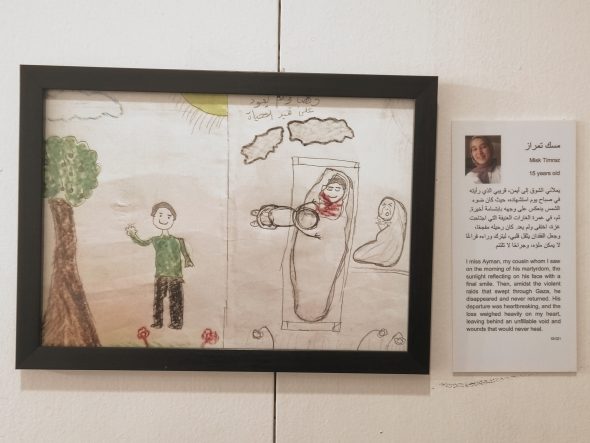
In one of her drawings, Misk depicts the final moments of her cousin, Ayman, just before violent raids took over Gaza. The wounds of loss and despair are etched deep into Misk’s heart, longing for her cousin to this day.
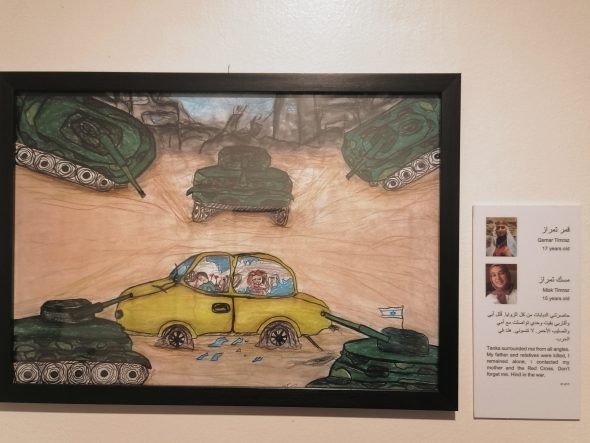
Another heartbreaking image featured is that of Qamar Timraz’s traumatizing experience against Israeli tanks surrounding them from every corner. Stuck in a car with her father and other relatives dead, Qamar can only hope for help and endure the sheer trauma caused by gruesome displays of violence around her.
For the observer, traumatizing is a tame word to describe the artworks that feature the extent of the genocide. These artworks reflect their lived experiences. What those children drew was real.
Death and destruction unfolded before their very eyes, and for the last two years, these were the sights that they had grown to live with.
Radical Optimism
While it is unnerving to witness sheer brutality among many of the children’s drawings, the artworks on display featuring mundane scenery are as disheartening. The absence of violent imagery and the overflow of innocent longing for what was once normal emphasize the lasting impact of barbarity.
Drawings of children usually feature impressions that their surroundings have on them. This innocent theme manifests itself in some of the less violent but equally moving artworks on display.
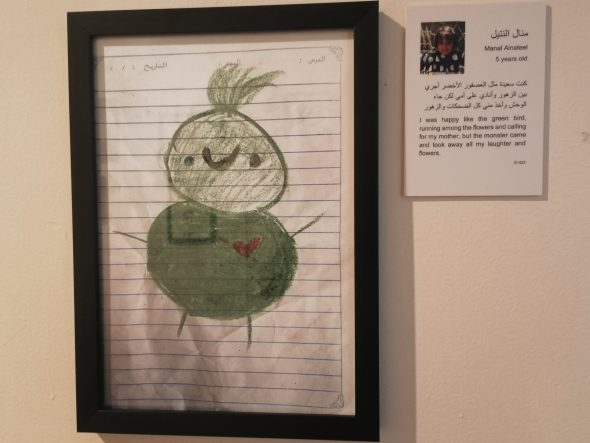
An artwork by Manal Alnateel, also 5 years old, features a harmless, smiling green bird. Like the green bird, Manal lived her life as any other child would have—happy, nosy, and carefree. All was well until the monster in the guise of tanks and bombs came and took away the sources of her joy.
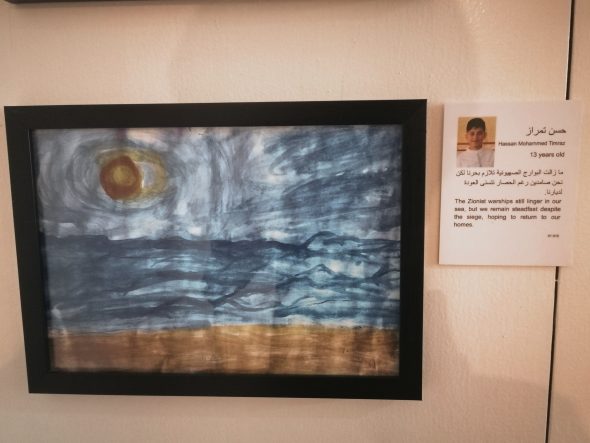
Not only do children pay attention to the wildlife they meet, but blissful sceneries are imprinted in their minds as well, evident in 13-year-old Hassan Mohammed Timraz’s drawing. It features the Palestinian shore, once calm, sunny, and idyllic. The seas are littered with warships now, but Hassan hopes that one day, they will return to their homes and bask peacefully in the sunlight.
These artworks contrast what most people look for when it comes to depictions of war. As one focuses on human casualties and destruction, one tends to forget that other forms of life take a hit as well. For Cura, Qamar Timraz’s artwork featuring the cats whom she had encountered, some killed and some lost, serves as a stark reminder that unsuspecting animals also fall victim to humanity’s barbarities.
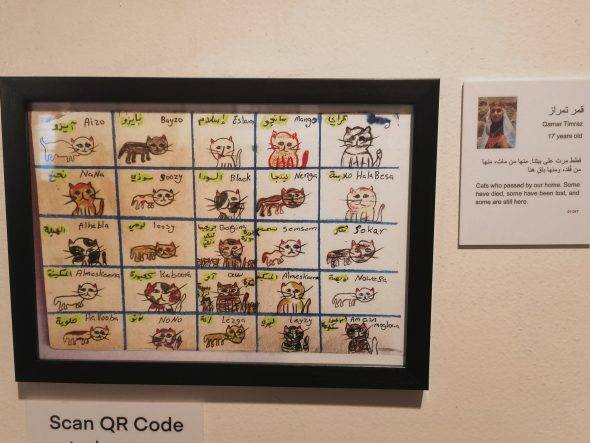
“Hindi lang mga bata, hindi lang mga babae, hindi lang mga tao ‘yung namamatay, kundi ‘yung mga hayop din. ‘Yung flora at fauna, ‘yung lupa, namamatay… Ecocide, ‘yun yung term nila. Reminder siya roon sa violence na nangyayari talaga, hindi lang sa tao, kundi sa iba pang mga nilalang, at sa kapaligiran ng Palestine,” she notes.
So even unwary cats are not spared; they are now also deprived of their right to exist. A stray cat, then, finds itself joining the 2 million Palestinians in the fight against merciless and senseless aggressors. Everywhere they look, anywhere they go, a stray cat can only see dust, debris, and despair. As Palestinians race towards safety, so, too, do their cats.
Alongside widespread casualties, reports have shown that Israeli aggression has reduced Gaza’s farmlands to packed earth, and its bombarded water facilities have effectively cut off water supply and sewage management. This has led to worsening levels of dehydration and diseases among the populace.
With Israeli forces having imposed a near-total blockade of food aid going into Gaza, the UN-backed Integrated Food Security Phase Classification declared that Gaza is experiencing phase 5 famine, the most severe phase of hunger, with more than a million Palestinians severely starving and nearing death.
But despite all of these harrowing scenarios, life goes on for Palestinians. For his birthday, 5-year-old Sobhi Al-Zaqzouq drew a cake stacked and sprinkled with strawberries, chocolate chips, and cookies. Just for a day, frostings and toppings became colorful stand-ins for missiles and guns as Sobhi and his siblings celebrated his birthday amid the genocide. For Palestinian children like Sohbi, war can never impede such events that mark a child’s ongoing legacy.
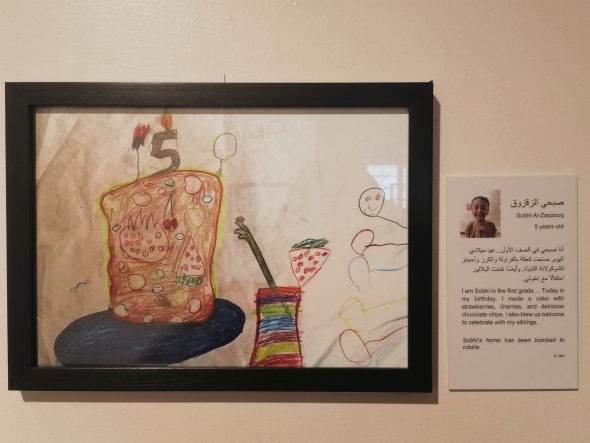
One might find it difficult to weigh which feeling overwhelms them more as they look at these drawings, devoid of any violence and filled with hope.
Shall we appreciate their optimism towards a return to normalcy? Or shall we feel all the more disheartened as uncertainty looms over their lives, and their wish for a childlike life is unguaranteed?
Nevertheless, one thing remains true: these children are the epitomes of courage. Their courage to confront traumatizing flashbacks and their courage to continuously hope for the better are beyond admirable.
These children could have prioritized their well-being because they do not deserve to revisit their days of loss. But still, these children manage to complete their artworks, from the theme down to the firm coloring of space. The hands eager to share overcome the minds hurrying to conceal.
The Heart of Gaza
The exhibit is proof that these children show no signs of backing down. Sprinkled among the artworks in The HeART of Gaza exhibit is hope. Hope for a better life, in a better future. They are scared, but they remain undeterred. With growing global condemnation against the genocide, Palestinian children are to be motivated than ever.
Cura expressed hope that as the exhibit runs its course here in the Philippines, more teachers and families can bring their students and children to view the artworks on display.
“Parang takot na takot tayong ipaalam sa mga bata na marahas ang mundo, pero itong exhibit na ito, dahil galing ito sa kapwa nila kabataan, I think mas maiintindihan nila [ng mga bata] ‘yung nangyayari,” Cura said.
She also invited artists to visit the exhibit, as she believes that art, as demonstrated by the children’s artworks, has the power to express and expose.
“Magagamit talaga siya [art] to serve the people, at tsaka ‘yung talagang nangangailangan ng inyong art, ng inyong talent,” she adds.
As one reflects on the heartbreaking artworks on display in the HeART of Gaza exhibit, one should be able to realize just how strong these children are. To be able to document what they have experienced and to relive disturbing scenes to share them with the world are acts that require years of resiliency to master—these children did it in months.
But these are children. Children who supposedly have all the time to explore the joys and ills of the world, soon. Yet they have managed to create something that has triggered the audience 8,850 kilometers away from home.
Today, as the genocide shows no signs of stopping, a stray cat joins the 2 million Palestinians in Gaza in the struggle to seek normalcy.
As Gaza continues to fight, Gaza shows signs of life. As Palestine slowly reclaims their rivers and drives out the warships in the sea, Palestine will be free.
Soon, a Palestinian child can seek food without waiting in chaotic queues again.
Soon, a Palestinian child can sleep soundly with their pet kittens without being targeted again.
Soon, a Palestinian child will enjoy freedom in his homeland. Again.
Because the children keep Gaza fighting.
For these children, sustain life amid the wasteland of rubble.
Because these children are the true heart of Gaza.