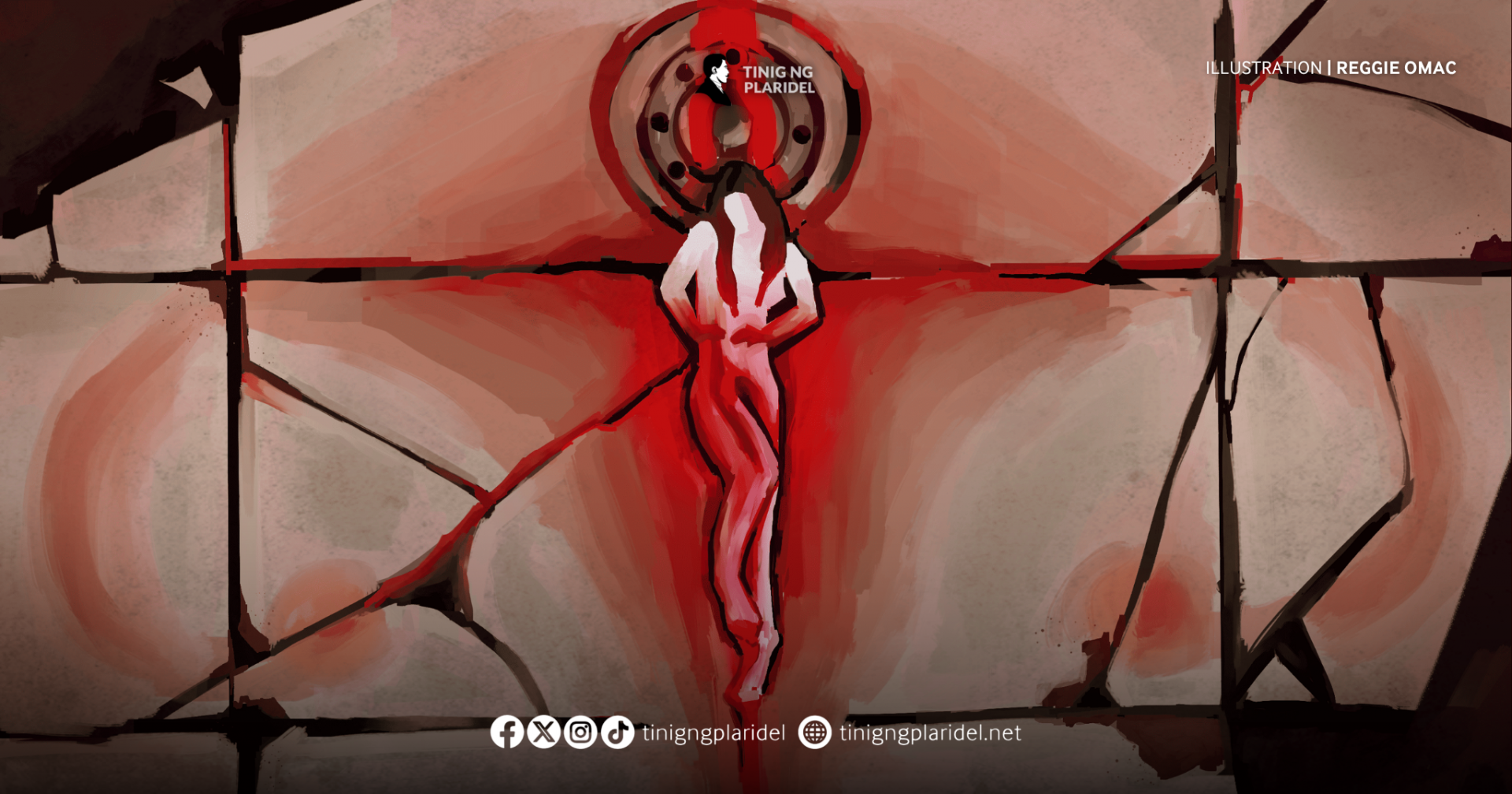
It claimed her underwear first, traced down her thighs then thickened into clots resembling the guts of the murderer they named her. It pooled beneath, rising, waterboarding its demands and suffocating her with its iron tang. Each movement of escape scalds the raw wounds inside.
Cries for her mother grew louder as bloodshed morphed her. Breasts tenderized, acne gouged into her skin and hair seeding across clean flesh. She begged to amputate the growths – to lacerate her vagina’s mound and empty it completely.
But then, they will crucify her for failing to bear the ‘light’ cross of menstruation. Her spread limbs mimic the oblation, but there is no honor in her sacrifice. She would not rise from the dead, not in the land of the nation’s scholars, which does not even have space to bury her bloodied body.
To bleed is to be human.
And dignified menstruation is to bleed humanely. It is the state in which menstruators are free from menstrual discrimination, including stigma, shame, abuse, restrictions, violence and deprivation of menstrual resources and services.
This freedom fades in UP Diliman, which echoes the state’s broader deprioritization of menstruators with neglected bathroom facilities, limited menstrual products, underfunding of Gender Offices, increases in pink tax and value-added tax (VAT) and stalled menstrual rights bills.
The patriarchal society refuses to show women mercy. Women face violence and misogyny, and now, even their basic bodily functions are dictated.
The moment a woman hears “Dalaga ka na,” she is reduced to a machine with two acceptable outcomes. To be impregnated or bear the red stain on her clothes — announcing how shameful she is.
Menstruation is stigmatized, leaving menstruators to endure physical, mental and systemic pains.
Regla ang tanging dugo na hindi bunga ng karahasan. Bakit ba ito ang pinandidirihan?
No hand to hold
They say UP will welcome you with open arms, but it will not hold your hand. Hopeful applicants soon discover that the institution they fought to enter could not even provide dignified spaces.
While proctoring for the UP College Admission Test (UPCAT) 2024, UP Diliman Budget Office (DBO) Coordinator for Admin Services Ronelyn Marasigan recalls an examinee at UP Integrated School (UPIS) whose menstruation leaked onto their chair during the exam.
Excused from the room, the student rushed to the nearest bathroom, only to find dysfunctional sinks and bidets.
“Nakakahiya kasi siyempre hindi siya comfortable [habang] nagte-take ng exam kasi natagusan siya. And yet ‘yong CR natin, sira [ang] gripo,” Marasigan said.
Despite advising the building administrator of UPIS to request assistance from DBO after the incident, Marasigan says no request was submitted.
According to Campus Maintenance Office (CMO) personnel Anthony Baniqued, the root of the problem is delayed reporting.
“Damaged plumbing fixtures, busted lights, leaks, defective doors and partitions and non-functional ventilation systems are not immediately reported to the office, which results in delayed action and prolonged inconvenience to users,” Baniqued said.
This UPCAT examinee is far from alone. Across 10 campus buildings, inadequately maintained bathrooms force menstruators into undignified spaces.
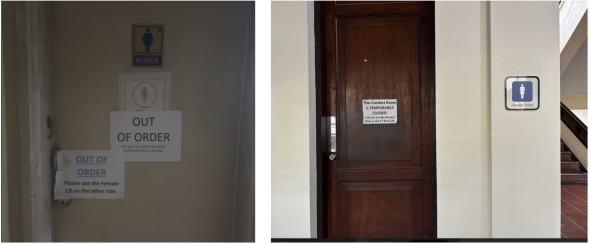
Bathroom samples were selected from high-traffic colleges and rooms, based on data from the Office of the University Registrar dated 2025.
A total of 28 bathrooms were assessed across 10 buildings: three each from Melchor Hall, the Institute of Mathematics (IMath), Palma Hall pavilions, Lagmay Hall, the College of Arts and Letters (CAL) New Building, Cesar E.A. Virata School of Business (VSB), Plaridel Hall and Vinzons Hall; and two each from Benitez Hall and the College of Science Library.
Bathrooms were evaluated using the World Health Organization (WHO) and the Department of Health (DOH) criteria on privacy and security, cleanliness, washing facilities and product accessibility.
Privacy and security refer to restrooms’ space and safety, including structurally sound walls and lockable doors. Only 83 out of 112 cubicles had adequate space across the campus.
In buildings with limited cubicles, many were unusable due to maintenance issues or broken locks. For instance, an IMath restroom’s two cubicles only had one that could be securely locked.
Even cleanliness remains a major issue in Diliman restrooms. Although 84 out of 98 toilets were clean and had trash bins, only a little over half of them had clean floors. While almost all of the flushes worked, extreme cases included Palma Hall’s first-floor bathroom, where nearly half the cubicles were closed, and none of the 11 flushes were functional.
Gabriela Youth UP Diliman Secretary-General Bunny Macato said these shortages remain a hurdle among menstruators, affecting their basic hygiene.
“Imagine, [kailangan] mong maghugas pero wala — nawawala talaga ‘yong tubig,” Macato said.
Even with 77 of 79 functional handwashing facilities, Tinig ng Plaridel found that 22 out of 28 bathrooms lacked soap, while only 34 cubicles had functioning bidets.
Meanwhile, only Melchor Hall’s second-floor bathroom had tissue paper and dispensers for wet wipes, tissue and napkins. Sanitary products are otherwise available only in a few on-campus stores, including ANTAS in Palma Hall, Robinsons Easymart DiliMall and the 7-Eleven at the Epsilon Chi Center.
Macato explained that while some buildings provide free pads during Women’s Month, menstruation — and the struggle for dignity — continues year-round.
Managing menstruation on campus extends beyond the bathroom. In fact, 8 out of 10 women experience period pain, with 1 in 10 having severe symptoms enough to disrupt their daily life.
For Macato and her peers, menstrual pain worsens with Polycystic Ovary Syndrome (PCOS), a common hormonal disorder that causes irregular cycles with both physical and mental strain.
RELATED: What PCOS warriors go through in fighting a lifelong battle
“Sobrang sakit ng cramps. Kung hindi cramps ay pati psychological kasi sobrang lala ng hormones doon,” she described.
With this kind of severe pain, getting around campus is no simple task. As a student from CAL, Macato must climb several flights of stairs just to reach classrooms and restrooms.
“Wala kaming elevator and five floors siya [CAL building]. So sobrang hirap magpunta sa mga class namin ‘pag may menstruation kami,” she said.
Bleeding on one’s terms
The agony does not end at the fifth flight. Cycles of stress, shame and struggle haunt students’ academics.
“One time nag-miss ako ng quiz kasi hindi talaga ako makabangon,” she shared. “[Sinubukan] kong magsulat ng email sa [professor] pero hindi niya tinanggap.
“[S]abi kailangan daw ng doctor’s note. Pero sa pagkuha kasi ng doctor’s note, depende siya kung may kakilala ka. Minsan, may bayad kapag kailangang magpa-reseta,” Macato added.
As a former track and field athlete, Macato even trained through her cycles to maintain momentum, yet some male peers undermined her pain and reduced her moods to menstruation.
“Kalakip sa stigma around menstruation, dina-dilute ulit natin ang pagiging babae sa pagiging emotional at hindi ‘yon tama. There’s layers to this. Menstruation lang pinag-uusapan natin pero sobrang daming issue ng kababaihan ay nakalakip doon,” she said.
These gendered double standards further extend to menstruators with diverse Sexual Orientation, Gender Identity and Expression (SOGIE) hardest.
Trans men and masculine women who menstruate often face scrutiny. Macato recalled professors’ and students’ knee-jerk eyebrow raises, questioning gender diverse menstruators’ cycles – a quiet gavel that polices who are entitled to bleed.
Some progress toward SOGIE inclusivity is evident, with gender-neutral bathrooms found in VSB and the College of Social Work and Community Development (CSWCD), but these measures only scratch the surface.
From the physical challenges of cramps to the weight of stigma, the demands of bleeding are real. These reveal the urgent need for better facilities, support, and understanding.
Bleeding on a budget
In an institution that has a limited budget, the cost of menstruators’ monthly, inevitable bleeding remains neglected, Macato said.
This is evident in the Diliman Gender Office’s (DGO) budget allocation of just 0.19%, a stark contrast to the 5% mandated by the Philippine Commission on Women.
“Although nandoon na [ang budget for facilities] sa kanilang GAD [Gender and Development] Plan and Budget, hindi nila napapagawan o [pina-prioritize] kasi nga kulang sa pondo,” DBO Administrative Officer Peter Villanueva said.
With expenses such as staff salaries and recurring events like Women’s Month, DGO’s limited budget is stretched across multiple initiatives, including providing menstrual products across campus.
“So kahit na gustong-gusto talaga natin na ilunsad ang kampanya [ng gender and reproductive initiatives], hindi siya magagawa kung kulang na kulang tayo sa pondo [at] sa suporta [sa] mga pasilidad,” Macato said.
Institutional units request inspections from CMO, which proposes a budget to the DBO and oversees procurement. Units also manage restocking of supplies in coordination with the Janitorial Service Providers across campus sectors.
But these shortfalls go beyond budget lines. They can have real, dangerous consequences. University Health Service (UHS) nurse Grace Santos recalls two recent cases of community members collapsing from dysmenorrhea.
To respond faster, UHS plans to strengthen ties with designated officers in each building for emergencies.
The primary healthcare facility provides students with rest, medication or referrals to specialists, while also distributing sanitary pads depending on the Quezon City Health Department’s stock.
“Kahit na naranasan natin ‘yong pangangailangan [ng menstrual resources and services] every month, hindi ito tinutugunan ng kabuuang administrasyon. Kita natin na hindi nila pina-prayoridad ‘yong gender minority,” Macato lamented.
Blood flows, statutes pause
While the cycle does not wait, legislation lags. Local governments like Manila, Aklan and La Union have enacted menstrual privileges and education, but national bills remain stalled.
Macato recalled lobbying for sex education and menstrual policies alongside Gabriela Party-list representatives but said that the invited minority groups were largely sidelined during the discussion.
“Puro lalaki ‘yong mga nasa room na ‘yon. Kahit na-invite ‘yong gender minorities, hindi naman sila binigyan ng masyadong oras na makapagsalita. At kapag nagsasalita sila, parang pumapasok sa isang tenga tapos lumalabas sa isa,” she said.
As of 2026, related measures filed by Former Gabriela Party-list Representative Arlene Brosas, Akbayan Party-list Representatives, and other lawmakers remain unenacted.
Although the Department of Health issued sanitation guidelines and UP upholds its ASH code, Macato asserted that these frameworks must be regularly reviewed to evolve and sustain menstruators’ needs.
For now, menstrual health support depends on who notices: a nurse, a classmate or a nearby office. Until stronger protections reach the root, care can only arrive after the body has fallen.
Blood, biology, bloodshed
It is a woman’s destiny to have her uterus shed itself. Warm and unapologetic, red relentlessly soaks through fabric and patience alike.
But it seems just as fated that she will sit in toilets that reek of neglect, wash at broken sinks that leave hands sticky with shame and wade through puddles of blood that cling to the cracks of society — so much so that menstruation feels like hell.
“If the bar is in hell, then hell has a basement. Ganoon ‘yong atake para sa mga kababaihan,” Macato described UP’s services and facilities.
There is little service in a campus that fails to meet basic standards for basic needs and no honor where horror prevails — not in her bleeding, but in her dignity bleeding away.
From neglected facilities to ingrained stigma, a woman’s biology is bemonstered: on display, surveilled and unshielded.
Her core is a political site layered with struggles, embedded in faltering progress and pervasive discrimination. Inevitably, the iron tang of indignity persists.
As she bleeds, her insistence refuses to yield.
She alone cannot prevent the crimson tides from surging beyond mere biology to bloodshed.
“Kalampagin natin ang mga administrasyon at ‘yong gobyerno sa kalahatan na i-recognize talaga tayo kasi ang dami ng danas sa pagiging babae,” Macato said.
Dahil hindi marahas at mas lalong hindi kahiya-hiya ang regla.
Ang totoong karahasan ay nakikita sa mga institusyong walang habas na kumakaltas sa dignidad at dangal ng kababaihan.