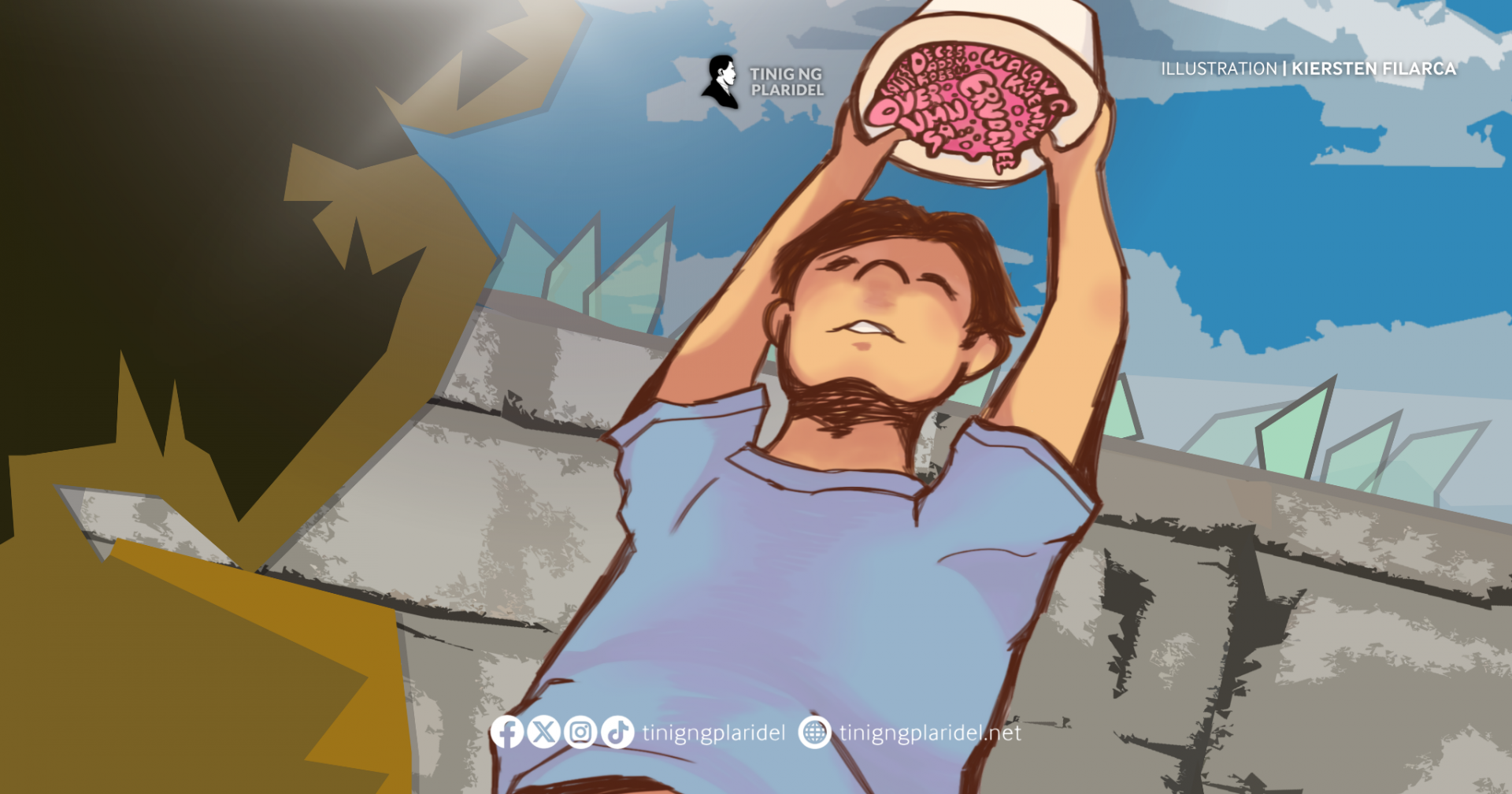
Yohoo! Holabels may kuwento akiskis. Kilala ba ninyey si Sesablech? Ah, eh, ah, eh, hydrogen? Akala’ed mo naman siya na susunod na iskrambol tropa, like is this tagalog? Go meldy, over’ed, buwelo.
Internet comedians are currently enjoying a surge in popularity. From TikTok to YouTube, their influence spreads far and wide across many social spheres. The catchphrases and complex vocabulary created by internet sensations cross the boundaries of the internet by being adopted by Filipinos, primarily the youth, in their daily conversations.
As social media democratized content creation, ordinary people stepped in to become social media comedians with fresh and relatable approaches. Their shift towards spontaneity and relatability eventually challenged mass media’s curated messaging and enabled greater visibility of marginalized voices in popular media.
While diverse expressions of humor nowadays may not cater to everyone, these are not grounds to deny their use. If anything, the very use of these comical expressions proves how they make specific groups of people feel seen and heard.
Market! market! of communities
The rise of social media and curated profiles paved the way for authenticity as an unmet need craved by its users.
The newfound creative liberty on online platforms and the creator’s consciousness of collective emotions allowed humorous content with various functions beyond laughter and applause.
Sparking the dogshow niche, content creator Mimiyuuh maintained her social media presence via comedic interviews with high-profile individuals.
From singer-songwriter Moira dela Torre to 2022 Presidential candidate Leni Robredo, their appearance in Mimiyuuh’s content features them exceeding their perceived social media presence. In using non-honorific language through the use of internet slang and humorous gestures, she portrays her guests as ordinary citizens that the audience is familiar with.
Having the former vice president of the country do the then-popular “skrrt!” gesture grounded her image with an influencer that people are used to relating to.
Such content resisted the common practice of utilizing formal language with personalities whose legitimacy rests on their audiences’ mandate.
Aided by her unapologetic queerness, Mimiyuuh’s interviews allowed public figures to be viewed beyond their habits.
Queerness has been a prevalent factor in the development of Filipino humor. Breaking the exclusivity of masculinity and femininity to rigid bigender criteria, queer Filipinos have barged into the social media scene with their own package of antics, resisting arbitrary assignments.
Though spanning different niches of humor, Iskrambol Tropa and Sesable have since built an online following composed largely of women and members of the queer community – sectors that have long been shunned, if not misrepresented and stigmatized in mass media.
Iskrambol Tropa’s demonstration of strength and Sesable’s affinity for feminine queer slang transformed conversations about empowerment by contrasting mass media’s prejudiced, often sexist assignment of observable traits.
By tapping into queer language and experiences, both creators have also established themselves as bastions of queer visibility in current times.
Mass media formerly set fitness standards in a binary standard, eventually leading to fitness-related advertisements for fiber drinks and lean protein products.
Parroting traditional gender expectations, the “fit woman” was portrayed to have proportional, enviable curves, while the “fit man” was expected to be laden with rock-hard abs and lean limbs.
Other emerging personalities have since resisted this notion with their transparent vlogs, detailing the ebb and flow of their respective fitness journeys.
For instance, the likes of Rasta Gutierrez (Rasta G) and jogging duo Carol Dagaang and Kevin Dalugdug (also known as Ka-breathless) have put up with their endless sulking and yearning for food during and after every running session.
Being tired enough to curse with every gasp for air and being hungry enough to crave two servings of kwek-kwek is a genuine reaction as they complete a five-kilometer run. For so long, fitness has been portrayed as a linear journey that is unwelcoming.
The ordinary Filipino lived for people who showed up with the imperfections of fitness journeys: running in obscure places like cemeteries and schools due to the lack of recreational spaces and craving food that has long been antagonized in the pursuit of physical wellness.
Somehow, what used to be a lifestyle reserved for the modern Spartan became more reachable even for the tamest souls.
Yet, “tame” cannot begin to describe the conversations popping up as of late concerning sex and cosmetic surgery—two well-known taboos in Filipino society. Despite this, discussions revolving around these topics have been popping up as of late and have been welcomed by large audiences due to their humorous nature.
We can partly credit the rise of progressive views on sexuality and beauty standards to content creators who have been openly discussing these topics in their own ways.
Sophie Prime has been able to bypass online censorship against libidorch and erbog content through creative and elaborate vocabulary.
Coupled with Toni Fowler’s explicit jokes and Bea Borres’ confidence in discussing cosmetic procedures, humor proved to be a tool to normalize such topics in a very conservative social climate like the Philippines.
After all, the Philippines is not one monolithic country in terms of its collective opinions’ trajectory.
A poll conducted by Pulse Asia in 2025 found that 73% of Filipinos approved of “age-appropriate” and “culturally sensitive” comprehensive sexuality education among school youth, signalling opportunities for fruitful discourse on sexuality and sexual health.
Content creators, if equipped with proper knowledge and experience, are capable of serving as peer advisors for audiences with limited access to high-quality information on sexuality education.
H-isturi time!
Humor has always been a cornerstone of Filipino culture, pervading both online and in-person social spheres.
However, the emergence of most Filipino comedy comes from: ayun, delubyo. In the face of destructive floods and increasingly concerning political issues, the common Filipino still summons the capacity to laff.
It is viewed as “resiliency” in action, using humor to cope, to face the absurd with even more absurdity.
Despite the notion itself being ridiculed, to face even the toughest situations like it’s just an ordinary day has resulted in a collective, shared feeling.
A vibrant media-loving base built on the experience of Filipino humor as a collective feeling, as Filipinos flocked to their neighbor’s television and big screens to laugh amid the hardships of life.
People use humor as a binding agent for certain groups, as a coping mechanism against injustice or trauma or as a mood shifter in tense situations.
With the way humor has been used to gauge and manage human emotions across many cultures, this tendency is more amplified in the Filipino context, given our culture of pakikisama or belongingness.
Motivated by persisting social ills post-EDSA, Filipino humor from the eighties until the early 2000s was dominated by political satire.
This was led by the likes of Gawad Plaridel recipient Jun Urbano as Dr. Shooli in the satirical program Mongolian Barbecue, featuring other political caricatures like Congressman Manhik-Manaog (Leo Martinez) and Juan Tamad (Eric Quizon) as symbols to Filipinos and the social ills they face.
Among Filipinos, humor can act as a “medium for cultural expression and community-building.”
Moving away from explicit social commentary was the late 2000s humor, which was defined with the rise of slapstick, campy and pilosopo humor led by the cinematic run of Director Wenn De Ramas, Aiai de las Alas, Eugene Domingo and Vice Ganda.
The all-encompassing nature of Filipino humor encapsulates its various uses across historic events.
So now, understand… ikot!
Much can be similarly observed in the appraisal of the current state of Filipino humor when art historian Alice Guillermo cautioned against the orthodox sociologizing of art.
While bigger social factors can shape the local taste for humor, Filipinos and their experiences may also shape the bigger changes in dominant humor from the bottom up.
To understand’ed is not the sole point of hu is mor. Rather, it is to experience joy as a collectivech that respects others’ banat. Humor creates a community not because it divides niches but because it directs people into spaces where they can feel most accepted.
The current landscape of Filipino humor deserves recognition for its daring move to challenge social expectations, power relations and dominant discourse.
Beyond what seems to be pure nonsense, if appraised solely at face value, has reshaped how we think and feel about established norms in society and popular media.