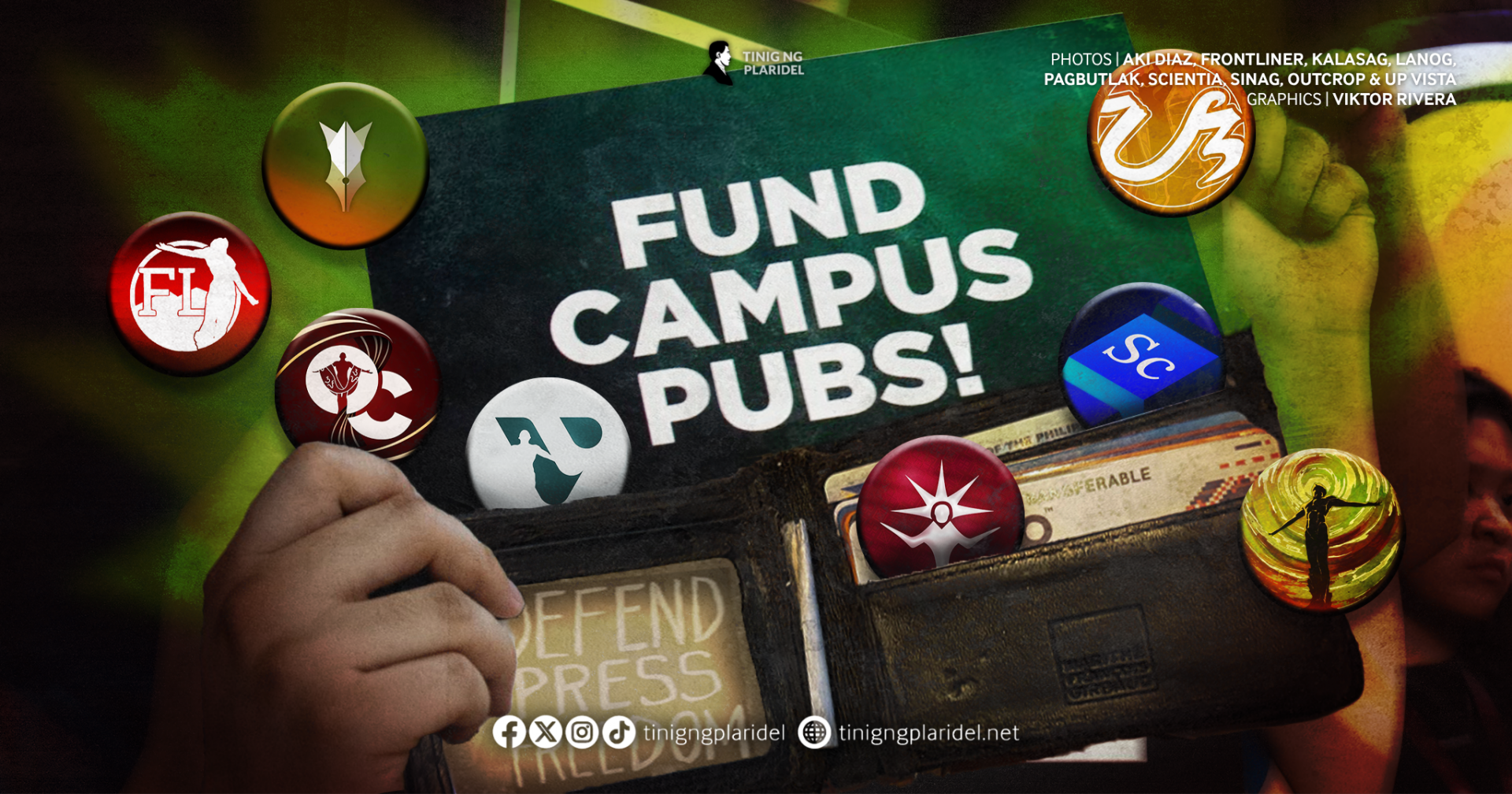
Access to funds remains one of the biggest hurdles for student publications across the University of the Philippines (UP) System, with many reporting persistent difficulties in accessing the allocations reserved for them.
Several UP campus publications said bureaucratic processes, stringent requirements and lack of fiscal autonomy impede access to their earmarked funds collected from student fees under the free tuition system.
The issue was raised during the biannual congress of UP Solidaridad last Aug. 5 at UP Mindanao, but UP student publications emphasized that they have long grappled with bureaucracy in securing funds.
According to the 2008 UP Charter, there should be a student publication established in constituent units and colleges to be funded by student fees collected from the tuition system.
Yet SINAG, the official student publication of the UP Diliman College of Social Sciences and Philosophy, has yet to access its allocated budget in nearly seven years.
Its trust fund now amounts to more than P1 million, SINAG editor-in-chief Eileen Kasan said via correspondence with Tinig ng Plaridel.
“The only answer that was given to us was that during the pandemic, the publication lost all access to its funds,” she added.
Kasan said the continuous delays have prevented SINAG from releasing a printed issue since the COVID-19 pandemic.
She added that staffers resort to out-of-pocket contributions to fund coverages, procure equipment and pay their website maintenance — which are expenses they intend to cover should the allotted funds become accessible.
Furthermore, the publication rents its office to other organizations and sells products during organizational fairs. Its alumni also give donations, according to Kasan.
SINAG is currently lobbying for its budget by submitting proposals and filling out the trust fund update from the Office of the Vice Chancellor for Administration (OVCA).
Kasan said, however, they are hindered by administrative bureaucracy.
“[I]t has come to our attention that even the college administration has no idea who is the approving body with regards to the budget access,” she said. “There is no exact flowchart or scheme about the process.”
Other UPD student publications facing problems accessing their funds are Philippine Collegian, Kalasag of the College of Arts and Letters, Scientia of the College of Science and Frontliner of the Extension Program in Pampanga and Olongapo.
The issue of bureaucratic processes extends beyond Diliman, as Pagbutlak of UP Visayas College of Arts and Sciences (UPV CAS) also experiences the same difficulties.
The publication currently has nearly P700,000 in its trust fund but still needs to seek approval from five offices to cover newsroom expenses through reimbursements and cash advances, Pagbutlak editor-in-chief Ella Villodres said in a correspondence with TNP.
After their adviser approves the request, the publication will write a letter for approval to the UPV CAS dean, which will be forwarded to the Office of the Vice Chancellor for Academic Affairs (OVCAA).
OVCAA will then send the request to the Accounting Office for review and the assessed letter will be endorsed to the chancellor. “Bureaucracy is the main hindrance,” Villodres said but added that they are thankful for having an adviser to help with the process while respecting their editorial independence.
In February 2025, this bureaucracy led to gridlock in the publication’s fund request when the CAS dean refused to approve it unless Pagbutlak sent an accomplishment report and a document on how it will improve its “journalistic ethics.”
It came weeks after the dean called the publication “unethical” for reporting the college’s delayed enlistment process. Villodres said necessary mechanisms should be in place to avoid such situations moving forward.
Other publications outside Diliman that are hindered in accessing their funds are Outcrop of UP Baguio, Vista of UP Tacloban and Lanog of UP Cebu, among others.
A years-long struggle
Based on UP Solidaridad’s database, the alliance has been passing resolutions for the funding and fiscal autonomy of student publications since 2023.
The alliance passed in January 2023 a resolution to ease bureaucratic processes in accessing student publication funds to eliminate the difficulties they pose.
The resolution stated that inaccessible funds prevent publications from printing issues, procuring equipment and attending important events.
SINAG, Pagbutlak, Kalasag, Outcrop and UP Cebu’s Tug-ani said paperwork hindered them from accessing their funds then.
Seven months later, the alliance approved in August 2023 a measure that asserted the student publications’ right to funding. It said that building relations between the university and publications should yield access to funds.
Outcrop, Tug-ani, UP Mindanao’s Himati and UPD’s Philippine Collegian are some of the publications that faced financial problems due to bureaucratic processes at the time.
The third resolution for the publications’ funding was passed by the alliance in February, urging the General Assembly of Student Councils (GASC) to campaign for the fiscal autonomy, funding and recognition of student publications.
UP Solidaridad then-chairperson Vyan Abella said publications rely on unsustainable projects, donations and solicitation.
More than half of UP student publications did not receive institutionalized funding at the time.
Meanwhile, TNP itself is facing difficulties in obtaining funding two years after its official recognition as the student publication of the College of Media and Communication (CMC).
The publication is currently funded through external media partnerships and alumni donations, despite a constitutional provision stating its allocations should come from student publication fee under the free tuition system.
Its efforts to attain institutional funding remain ongoing with the CMC administration.