The 2018 Metro Manila Film Festival has been plagued by controversies even before it had begun. Apart from the criticism towards its predictable film line-up – a Vic Sotto and a Coco Martin crossover action-comedy, a Vice Ganda fantasy-slapstick comedy, two horror films, two romantic comedies, a romance drama, and a family drama – off-screen controversies continued to surround the festival.
One such controversy involved the calls circulated online to boycott Vice Ganda’s film Fantastica. This is due to the allegations of bullying remarks made by Vice Ganda at the expense of Senator Antonio Trillanes and Leila de Lima, and unconfirmed rumors of the actor being a Marcos supporter. In the opening days of Fantastica, reviewers were keen to spot crude and tasteless jokes in the movie which they considered inappropriate for its young target audience. The producers of the movie were reported to have slashed down the price for the tickets of Fantastica by half of its original cost as well as to have offered free popcorn in hopes of still breaking even despite the boycott.
The horror movie OTLUM also received flak online as its running time was reported to be just a little over 60 minutes long. Because of this, the selection committee was criticized for including such a film deemed a cash grab to the lineup for the sole intent of generating profit.
The MMFF’s Board of Jurors was not any less controversial as SAP Bong Go was elected to be part of its jury. He was first asked to be the chairman of the Board of Jurors. The senator aspirant can be seen in promotional videos for the festival, leading one to surmise that the festival was used as an overt political vehicle for his publicity rather than a stage to forward the state of the country’s film industry itself.
And it is a legitimate allegation. The whole history of the Metro Manila Film Festival is shrouded by politics itself – from its inception as a cultural weapon by the Marcoses, to a mere money-profiting scheme in recent years by the MMDA. With a redirection from the 2016 lineup that showcased meaningful and substantial films, the festival reverted back to its tendency to focus on making money with a compromise in 2017. Last year, however, it seems that the MMFF has completely turned away from the promising direction that it set in 2016.
Rainbow’s Sunset – a misfired mess
Many were ready to give up on the complete lineup of the festival. Except for one film – the Best Picture winner Rainbow’s Sunset. Every year, the Best Picture winner remains the glint of hope that is set aside from its contemporary films as the superior film worth your time. That, however, is not the case for 2018.
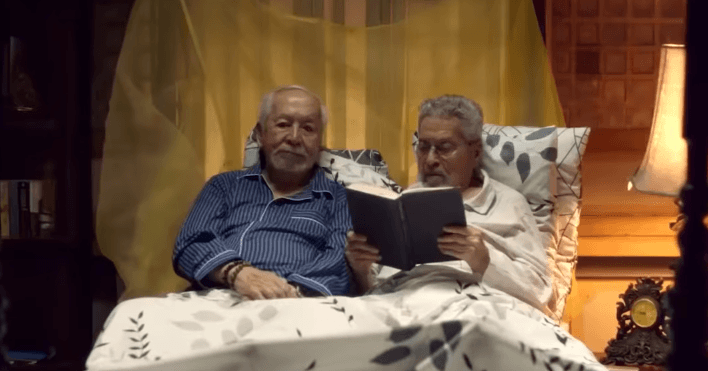
The strongest genre for local cinema is arguably the family drama. Many Filipino classics were family dramas, so amidst the slew of films in this year’s festival, Rainbow’s Sunset was anticipated, especially considering its themes. Movie stars Eddie Garcia and Tony Mabesa were featured as close childhood friends become elders coming into terms with their extra-marital homosexual relationship, with Ramon Estrella (Garcia) outing himself in front of his children in the dawn of Fredo’s (Mabesa) life due to cancer. The movie sets this story up early in the film, but barely touches it in the following acts.
What seems to be a movie about the acceptance of one’s sexuality is actually something that concerns itself of it the least. None of his children really did accept Ramon and Fredo because they were gay. They accepted them because the two were the padrino-providers of the family– a common problematic trope in local queer films.
The film has serious writing and pacing issues. Fighting for screen time are several other loose, convoluted subplots that are either unresolved or used to artificially advance the story. One was about Emman (Tirso Cruz III), the first-born of Ramon, dealing with his relationship with his lesbian daughter, which was altogether dropped after the subplot was established. The supposed main story of the two gay lovers became an afterthought in order to service the self-absorbed stories of the children.
Most characters are inorganically written– as if they were one-dimensional caricatures. Melodramatic tropes were heavily and tiringly used. The movie was reminiscent of a heavily budgeted MMK episode. What was marketed as an LGBT-friendly movie turned out to be a very problematic and dangerous narrative, aside from its serious technical misgivings. The only laudable aspect of the film had been the acting of Eddie Garcia, Tony Mabesa, and Gloria Romero as the family’s matriarch.
Still, the winner of the Best Picture Award at supposedly the most prestigious film festival in the country may be a strong contender as the worst film of the year. This fact shows just how much the MMFF has fallen in grandeur. Only another tremendous redirection of the festival may save it in the coming years.
However, many have given up hope. With the festival ending last January 7 hitting a reported P1-billion mark, the MMFF is unlikely to abandon its money-making schemes in favor of actually advancing the local film industry.
Not the face of Philippine Cinema
The MMFF may have been a lost cause but to say the same of the local film scene is misguided. 2018 has seen many remarkable films from different studios, producers, and other festivals alike, ranging from mainstream to independent. Various films received critical acclaim here and overseas that truly deserved them.
There are other fronts in the industry aside from the MMFF which offered some of the best films of 2018. Cinemalaya features up-and-coming young directors, including Kip Oebanda (Liway), Carlo Enciso Catu (Kung Paano Hinihintay Ang Dapithapon), and Che Espiritu (Pan de Salawal).
ToFarm has given us fresh new narratives that would otherwise never be shown, such as Tanabata’s Wife (Charlson Ong and Lito Casaje) and the sci-fi Alimuom (Keith Sicat).Pista ng Pelikulang Pilipino provided even more quality films with Signal Rock (Chito Roño) and Balangiga: Howling Wilderness (Khavn Dela Cruz). QCinema also provided a fresh batch of great movies in Samantha Lee’s Billie and Emma, Dan Villegas’ Hintayan ng Langit, and Dwein Baltazar’s Oda sa Wala, who also made waves internationally with Gusto Kita With All My Hypothalamus that was screened in CineFilipino.
Cinema One Originals remained brave in showcasing brash and dauntless films like Never Tear Us Apart (Whammy Alcarazen), Mamu, and A Mother Too (Rod Singh), A Short History of a Few Bad Things (Keith Deligero), and the only animated feature of the year, Paglisan (Carl Joseph Papa).
Mainstream lovers also got their fair share of notable films in Goyo: Ang Batang Heneral, Never Not Love You, Buy Bust, Citizen Jake, Sid & Aya: Not A Love Story, and Meet Me in St. Gallen.
The old hallmarks may be unredeemable, but there are other ventures for Filipino filmmakers to make films worthy of the audiences’ time and attention. We do not need institutions to forward the craft of filmmaking. If there is viable enough talent to be shown, it will be shown.
The MMFF is not the face of Philippine Cinema, nor of the past years since its conception. But it is rather still a hard reminder that many more obstructions linger in the industry, due to the powers that be.