
Story by K.C.
As the University of the Philippines (UP) opened its doors to first-year students for academic year 2022 to 2023, students across the country apply to UP despite the political and educational turmoil that trouble the university.
In a May 25 statement published on its Facebook page, the UP Office of Admissions reported that it received over 100,000 applications for the 2022 UP College Admissions (UPCA), which decides the entry of high school students to the university’s next academic year starting September.
For the aspiring Iskolar ng Bayan, the maroon path is a journey worth taking, despite the vilification that UP faces from state agents, trolls and even its own administrators.
Among the first-year applicants is Grade 12 humanities and social sciences student Iza Sumang, who went through online applications this year in the hopes of easing her family’s financial burden.
“Ever since bata ako, dream school ko na siya (UP) at hindi rin ganoon kayaman ‘yung family namin para i-shoulder ‘yung fees [ng private school],” she told TNP. “Mas madali kung sa UP ako since hindi na problema ‘yung tuition.”
In 2021, the UPCA replaced the UP College Admission Test (UPCAT), which was a pencil-and-paper exam that assessed an applicant’s proficiency in language, science, mathematics and reading comprehension. University executives said they had to halt the UPCAT due to “logistical concerns” brought by the COVID-19 pandemic.
RELATED: UP admissions portal malfunctions on first day amid surge of applicants, tech hiccups
The UPCA retained the UPCAT’s university predicted grade (UPG) system, which decides which of the university’s campuses nationwide an applicant could enter.
According to UP admissions office Director Francisco delos Reyes, 70% of the UPG for the UPCA last year was taken from academic excellence — a “composite of the final grades in Grades 8, 9, 10 and 11.”
The remaining 30% is for economic and geographic equity.
“We have considerations for economic equity so siyempre ‘yung mga hindi kaya magpaaral,” Francisco told Rappler in 2021. “May mga tanong ‘yan sa application form. Kung nasa malayong lugar, bibigyan ka namin ng chance.”
To “democratize” admission opportunities, the university implemented the Excellence-Equity Admissions System in 1997, which considers an applicant’s geographic location, socio-economic status and academic performance in computing the UPG.
The university allows applicants to pick their two most preferred UP campuses, and a set of degree programs for each choice. Sumang said her first pick is the journalism program in UP Diliman.
While the university did not show exact figures, UP and its executives have announced that over 100,000 students have applied annually in the past five years, following a two-year applicant drop in 2016 and 2017 due to the implementation of the K-12 program.
If admitted, the applicants would be entitled to free tuition and miscellaneous fees under the Universal Access to Quality Tertiary Education Act, which was signed in August 2017 with a vision of helping students pursue higher education.
This law comes after years-long protest from the youth for free education, and the abolishment of the university’s socialized tuition system, which former UP Student Regent and now Kabataan Party-list Rep. Raoul Manuel criticized as a “scheme to earn profit from students.”
Thirdie Mannan, a science and technology student graduating from a private school in Rizal province, said UP’s tuition-free education “will be of great help” to his family’s finances. Mannan said he aspires to take business administration in UP.
“It is important for me because passing [the admission process] entails receiving high-quality education and paying [for] lower fees,” he added.
Supporting Mannan is his mother, who works overseas as a domestic helper. Even if his mother were working in the Philippines, Mannan said he would still apply to a state university so he can study without tuition.
“Siguro factor ‘yung financial stability kasi kahit ‘di siya overseas Filipino worker at kung dito siya nagtatrabaho pero maliit naman ‘yung sweldo, pipiliin ko pa rin talagang mag-State U,” he said.
According to the UP Charter of 2008, the university has the responsibility of bringing education closer to students who are in need by making its admission process “equitable.”
Despite this, the 2022 UP School of Economics study revealed that from 2006 to 2015, applicants from richer households had a higher chance of not only entering UP, but also obtaining their top-pick courses.
Adding to this challenge is UP’s traditionally low acceptance rate. Last academic year, delos Reyes said that out of more than 100,000 applicants, only around 11,000 were admitted to UP campuses nationwide.
While UP prides itself in serving the masses and advocating for learning for all, it also becomes a battle arena where students compete for limited tickets to free education.
Still, Mannan is inspired by UP’s reputation of excellence, as he said UP students are “automatically geniuses.”
“When people discover that you’re studying at UP, they either believe you’re talented or extremely intelligent, and I consider it an honor to be labeled like that,” he said.
The 2022 Quacquarelli Symonds ranking of higher education institutions puts UP on top of Philippine universities, placing 77th in the rank for schools in Asia.
“I want to see how much further I can go, and how UP will help me hone the person I want myself to be,” Sumang said.
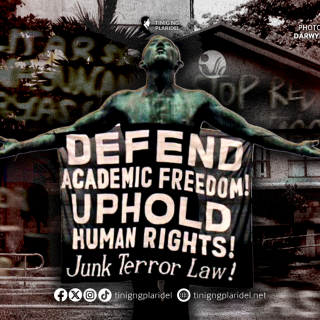
On the flipside of the university’s good marks, UP is a frequent target of red-tagging allegations from state agencies and trolls online, which baselessly link the university to the communist insurgency.
READ: Red-tagging of UP students, orgs worsened during pandemic — student councils
It was these allegations that prompted the Department of National Defense to abrogate its accord with UP in January 2020, which barred military forces from entering UP campuses without prior notification to university officials.
The UP-DND accord was signed in the wake of abuses against the university’ students during the martial rule of dictator Ferdinand Marcos Sr.
The UP community also contends with the incoming presidential term of Ferdinand Marcos Sr.’s son and namesake, Ferdinand Marcos Jr., who the UP Diliman University Student Council called the “number one burden of the Filipino people.”
Sumang admitted that the ceaseless red-tagging attacks on the university made her anxious as an aspiring UP student. Still, she said it did not stop her from continuing her application, adding that university officials should defend its students.
“It gave me more motivation to enter UP,” Sumang added. “Given the rampant news about the university, mas na-curious ako na malaman how they (UP) handle these kinds of issues.”
Results of the UPCA for AY 2022-2023 will be released tomorrow, May 31, through the university’s application portal.