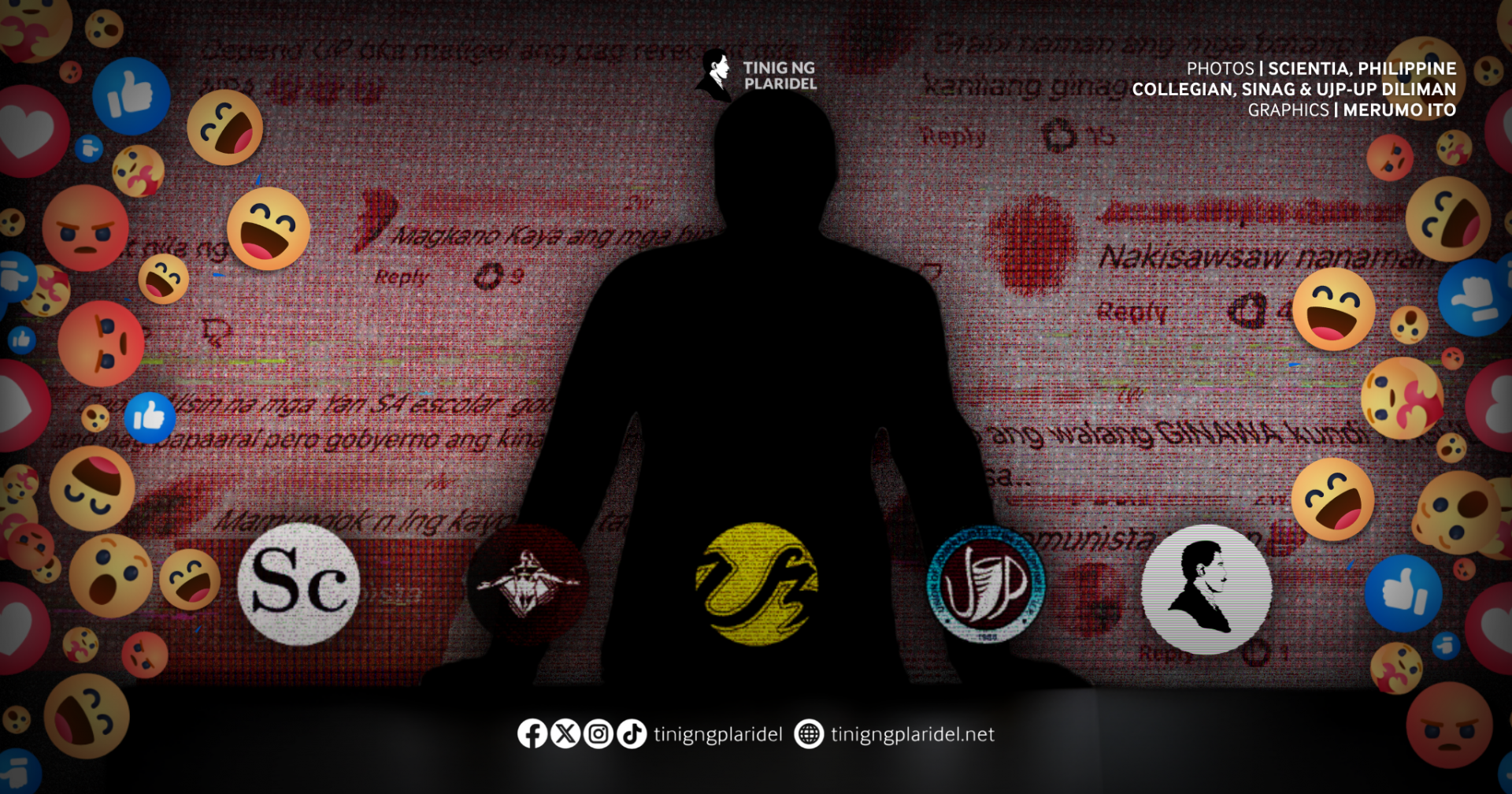
As people flooded the streets in protest against government corruption over the past months, a wave of irregular troll activity also swamped the online pages of student publications.
Sentinel flagged patterned fluctuations in Facebook engagements of active University of the Philippines (UP) Diliman student publications between September 2025 and February 2026.
Reports on mobilizations tallied an unusually high number of reactions, comments and shares compared to the publications’ average engagements on Facebook.
A total of 161 out of 235 flagged posts were protest-related. The Philippine Collegian, UP Diliman’s official student publication, accounted for nearly half of these reports.
Among the five active publications investigated by Sentinel, the Collegian had the highest follower count with more than 280,000 followers.
One of their most widely reached posts was a Sept. 21 video of protesters marching along Mendiola, Manila, demanding accountability for recent corruption cases, which coincided with the commemoration of Ferdinand Marcos Sr.’s declaration of Martial Law in 1972.
Although Collegian Editor-in-Chief (EIC) Reg Dipasupil admitted observing trolls as early as 2022, he said the flood control fiasco prompted an increase in troll activities.
Starting from President Ferdinand ‘Bongbong’ Marcos Jr.’s revelation on state corruption, newsrooms have intensified their investigations on anomalous flood control projects until the systemwide walkout across UP campuses in September 2025.
RELATED: UP student leaders call for budget transparency amid delayed infra projects
After collating reports from different newsrooms, the top three posts with the highest engagement featured clashes between protesters and state forces during “Baha sa Luneta,” reaching 312,334 reactions, 8,992 comments and 34,751 shares on Facebook alone.
This sparked the first spike in engagement on Diliman student publications’ mobilization reports, following walkouts and other occasions like the commemoration of the 1986 EDSA People Power Revolution.
Diliman newsrooms’ Facebook comment sections saw an increase of up to 12,511% in their highest-engaged posts compared to the average comments they receive.
Sentinel found that reports on seeking accountability from President Ferdinand Marcos Jr., Vice President Sara Duterte and former president Rodrigo Duterte have garnered significant social media attention. Their names appeared in 67, 57 and 14 flagged posts, respectively.
The Collegian and Sinag, the official student publication of the UP College of Social Sciences and Philosophy, confirmed that most of their troll engagements contained red-tagging and derogatory messages.
“We have observed that these social media entities do not have a natural or organic profile, dubious, and are parroting the same messages on our comments section,” former SINAG EIC Jenelle Raganas said in a correspondence with Tinig ng Plaridel.
Some of the comments used the term “corned beef” in the context of killing activists and revolutionaries, according to UP Solidaridad’s Media Safety Officer for Metro Manila Jeremiah Li.
“‘Yong implication niya [laugh reacts and negative comments] is parang hindi na nase-seryoso ng mga Facebook users ‘yong mga nangyayari. Kung may namatay, parang tatawanan siya as if parang lahat ng content sa social media is entertainment,” he said.
Peer-reviewed research showed that netizens are at risk of replicating malicious online behavior once exposed to troll activities, especially when they have low empathy and share the same beliefs and ideologies with trolls.
While Li noted that troll engagements are “inevitable” for publications, he said that UP Solidaridad — the systemwide alliance for UP student publications and writers’ organizations — encourages its members to delete harmful comments. These include remarks that may have adverse effects on the mental health of students and staffers.
Despite documenting multiple reports of social media troll attacks during last year’s biannual systemwide congress, UP Solidaridad has yet to file a resolution addressing information-interfering activities.
READ: Social media censorship, online attacks hound UP student publications
The Collegian, meanwhile, is set to codify an internal moderation policy that aims to address comments that pose a threat to the authors, publication and the public.
“We underscore the importance of our comment section in providing a space for thoughtful criticism,” Dipasupil said, as long as the discussion remains harm-free.
Li said that “bad publicity is still publicity,” expressing their optimism in reaching a wider audience and educating the people behind inauthentic accounts.
“[Para] kanino pa tayo nagsusulat, ‘di ba?” Li said. “Kung mananatili lang siya sa university, magiging echo chamber siya.”
This is a developing story.
This Sentinel report was produced under the story grant of the Philippine Center for Investigative Journalism.
Methodology:
Facebook posts of Scientia, Tinig ng Plaridel, Philippine Collegian, Sinag and the Union of Journalists of the Philippines – UP Diliman Tambuli were scraped using Apify.
The mean average of the total comments was used as an indicator of a flagged post. If the number of comments is higher than the average, it is gathered on a separate sheet together with other flagged posts.
Using Google Sheets, the author individually cleaned and manually extracted information regarding language, topic, content, media type and date of publication. The pivot tool was used for analyzing content.