
Ninety-seven years.
That’s how long the Philippines had to wait before Hidilyn Diaz lifted the nation to its first Olympic gold medal during the 2020 Tokyo Olympics.
With the weight of an entire community steadied above her shoulders, the Zamboanga native dropped the barbell and burst into tears after quenching almost a century of golden drought with a total lift of 224 kilograms in the 55-kg women’s weightlifting division of the quadrennial meet.

But Diaz’s triumph was more than just a medal — it was a statement proving that strength and sports know no gender.
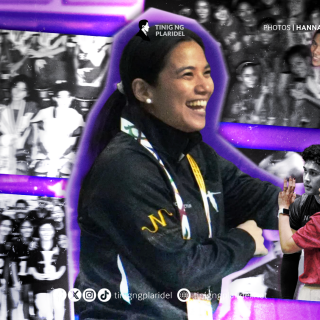
“Hindi siya medal lang,” Diaz shared in an interview with Tinig ng Plaridel.
“We have the responsibility to influence athletes [and] young women,” she added, reflecting on her beginning in Zamboanga, where she first learned to carry past weights and stereotypes.
Life in Zamboanga
It wasn’t all gold and glory for the first-ever Filipina Olympic gold medalist at first.
The young Hidilyn was raised in a family of eight in a small bungalow in Mampang, Zamboanga, where even access to clean water was a daily struggle.
As the daughter of a farmer turned tricycle driver, Diaz initially dreamed of becoming a banker to help ease her family’s financial struggles. Sports were the furthest thing from her mind.
But not until a local weightlifter, Elbert Atilano, and her cousin Catalino saw potential in her “brusko” build.
“I started from nothing,” Diaz shared. “’Yong mga cousin ko na lalaki ‘yong nag-influence sa akin. Na-curious ako noong nakita ko silang nagbubuhat.”
“Sa ibang sports, malalakas sila. Sa weightlifting, nasasabayan ko sila,” she added.
Hidilyn started training with an ipil-ipil branch before using a makeshift barbell crafted from plastic pipes with cast concrete weights or jeepney mags at both ends.
At times, the young Hidilyn would sell vegetables and fish and wash jeepneys to afford transportation fees to train at a local gym.
However, it wasn’t just the lack of proper equipment that Diaz had to overcome early in her career. It was the struggle against societal norms of a male-dominated sport.
“Growing up, ‘yong nanay ko mismo [ay] ayaw niya ako mag-weightlifting,” she said. “‘Yong tingin niya ay [ang] weightlifting para sa lalaki lamang. [Ang] babae, doon sa bahay, dapat maglinis [at] dapat gawaing-bahay ang gagawin.”
“So growing up, naging insecure ako sa sarili ko,” she added. ”Hindi ako proud sa muscle [at] sa sports na sinalihan ko.”

While Diaz would eventually nab gold during her first-ever weightlifting tournament in the 2002 Batang Pinoy, Hidilyn lifted more than just the winning weight. She carried the quiet burden of underrepresentation.
“Gold ako sa Batang Pinoy dahil wala ‘kong kalaban. So meaning, ako lang mag-isa. Wala pang masiyadong representation of women in weightlifting,” Hidilyn shared.
Raising the bar
Despite lacking equipment and representation, Hidilyn continued to pursue weightlifting, finishing bronze in the 58-kg bout in her first Southeast Asian Games in 2007.
Unaware of what the Olympics truly were, the 17-year-old Hidilyn found herself as a wild-card entry who finished 11th out of 12 competitors at the 2008 Beijing Olympics.
“Sabi ko next time, ayoko ng wildcard lang. [Sa] 2012 gusto ko mag-qualify na,” Diaz said.
While Hidilyn would secure yet another ticket and become the Philippines’ flagbearer in the 2012 Olympics in London, she recorded a DNF (did not finish) after three unsuccessful 118-kg attempts in the clean and jerk.
At the time, she was weighed down by mounting injuries and the unexpected departure of a trusted coach.
“Sa 2016, gusto ko mag-qualify. ‘Yon ‘yong goal ko. ‘Yong dream kong mag-qualify at manalo,” reflected Diaz.

Four years later, an injury-riddled Diaz aptly bucked to pain for the glorious gain as she became the first Filipina to win an Olympic medal after a silver lift in the 2016 Rio Olympics.
“May injury pa ko niyan [2016 Rio Olympics]. Paano na kaya kung wala ‘kong injury?” quipped Diaz, already setting her sights on the gold medal within an arm’s reach.
Writing ‘herstory’
The road to gold for Diaz was shaped by unexpected circumstances.
Long before her Olympic triumph, she experienced a different kind of weight — controversies and uncertainties regarding her status as an athlete.
Despite being one of the country’s most promising Olympians, Diaz openly struggled with inconsistent funding. She even turned to social media to ask for financial support, exposing the fragile reality that even medalists like Diaz are still left to fend for themselves.
Circumstances beyond her control also pushed her even further when she was left stranded in Malaysia for 19 months during the pandemic. Diaz trained in a rural residence in Melaka, offered by a Malaysian supporter who assisted in her preparation.
However, what could’ve been setbacks became a turning point for Diaz.
“Kung hindi ako nabigyan ng additional one year [to prepare pa], hindi ako naging mas malakas pa,” stated Diaz.
On the Tokyo 2020 Olympic platform, the weight of the Philippine athletic legacy rested on her shoulders. She wasn’t just lifting a barbell; she was bearing the dreams of a nation, all hoping for a gold medal.“Sabi ko kaya ko mag-gold. Ginagawa ko ‘to para sa Pilipinas,” she said.
Even before the competition, she had been moved to tears as she knew that she would win.
“Parang hindi iba ‘yong feeling [ng] moment na nandoon ka, nasa harap ka. [Iniisip] ko na kailangan ko lang ‘tong buhatin,” Diaz recalled.
“One motion,” she repeated as she lifted the barbell, her body trembling under the weight. But she persevered.
And then, she let it fall.
“Philippines, the wait is over. The gold is yours.”

Bearing a new weight
Six years after making history at the Tokyo 2020 Olympics, Diaz embraced a new role, now bearing a weight that extends far beyond the competition platform.

On January 19, 2026, the University of the Philippines Diliman announced the addition of Diaz as an instructor at the College of Human Kinetics (CHK), teaching two PE 2 weightlifting sections this second semester.
Despite weightlifting’s growing presence in national competitions like the Palarong Pambansa, Hidilyn saw how little recognition it received, prompting her to teach it to the next generation.
“Kung magtuturo ako dito [sa UP], kung ano ‘man ang curriculum ko, [I am] hoping na ma-share ko ito sa ibang university para makapagturo [din] sila,” she said, aiming to create a ripple effect of weightlifting through an academic setting.
Her vision is clear — to establish the sport and allow people to understand its value as a discipline and as a possible career for Filipino athletes.
“We are making [a] path for them,” shared Diaz. ”’Yong role ko is opening doors for the young generation.”
However, for Diaz, true success is not confined to medals and awards — but in making space for Filipino athletes to reach platforms like the Olympics.
And in carving out that space for the country’s athletes, she continues to challenge outdated perceptions about women in sports, proving that excellence transcends gender.
“Walang gender ang sports. Just do your part kasi wala naman kung babae o lalaki ka,” she said.
While the challenge of carrying the responsibility for the next generation of athletes continues, everything remains worth the weight for Hidilyn.