Trigger Warning: This article contains descriptions of depression and suicide.
In the theater’s dimness, a persisting spirit lingers underneath the stage lights. His voice begs to be heard beneath the band’s riffs as his wisdom seeps between every line spoken.
He was an innovator of his time. The mind that brought our university’s theater to life. Legacies are often framed as grand, complicated feats, but he proved that all it takes is passion and a cooler of fresh fruit.
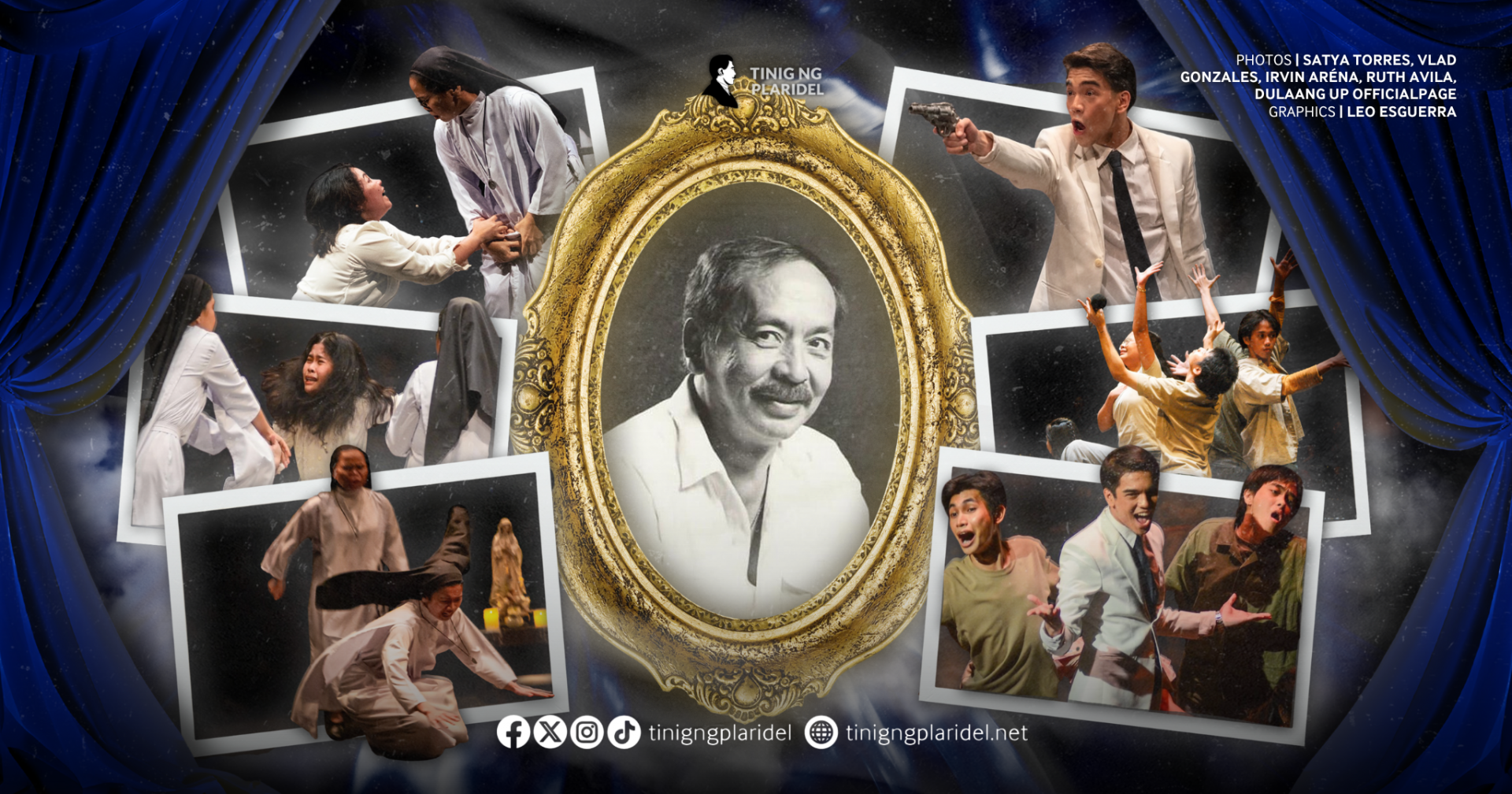
In its 48th season, Dulaang UP honors the legacy of National Artist for Theater Tony Mabesa through Para Kay Tony: Tungo sa Ginintuang Alaala — a thoughtfully executed tribute featuring a twin bill of two Filipino classic plays.
Although these works originate from a more traditional era of Philippine theater, the stories they tell transcend the thresholds of time and continue to remain relevant.
When the curious meets the rigid
It’s wonderfully eerie walking onto the set of Lloyd Sarmiento Uy’s direction of Kalahating Oras sa Isang Kumbento. A solitary lamp hangs over the circular stage as two candles light an altar below. Just before the show starts, a lullaby-like tune taunts you in the background. Then, just as you’re drawn to the motion of the candles and the stillness of the wooden furniture, a girl in white rushes across the theater catwalk — in tears.
Her name is Yolanda (Rona Lynne).
Wilfrido Ma. Guerrero’s hour-long piece unfolds as Yolanda is thrown into turmoil after confiding in one of the convent’s servant boys. In her longing to be seen and heard, she clings to his rare flicker of empathy, unaware of the trouble it will bring. Soon, her ache is weighed not by sympathy, but by authority
Three nuns debate her fate: Mother Superyora (Sheryll Ceasico) insists on her expulsion, Sister Vitalis (Paulyn Abando) argues for compassion and Sister Theresa (Gena Suelto) condemns Yolanda, who pleads with everything in her power to stay in the convent.
Though the narrative itself is quite compact, its underlying themes are anything but. Young, frightened and reaching for something she can’t yet name, Yolanda represents a generation of Filipino youth trapped in a cycle of religious conservatism.
As this long-held culture tightens its grip, Yolanda’s mind reaches for things beyond what is permitted, startling those around her. There is a spectrum of rigidity in this aspect of Filipino culture as it’s vividly embodied in Mother Superyora’s unbending authority, Sister Theresa’s harsh judgment and Sister Vitalis’s gentle yet deeply conflicted care.
As tensions escalate and draw you deeper into the story, the casting choices begin to make perfect sense. Mother Superyora does not need to raise her voice. Her aura alone is stern and unforgiving, which is a commendable contrast to the softhearted demeanor of Sister Vitalis. A real standout is Sister Theresa, whom audiences will have no hard time hating. Her brief time on stage does nothing to diminish the bite of her sharp-tongued bully.
Paired with the skilled cast is the play’s raw rendering of mental illness in young people. There’s even the nuns’ immediately recognizable remarks of “Depressed ka? Mag-pray ka lang,” or “‘Pag tanda mo, saka mo sabihin ’yan,” which audiences know too well from real life.
There is a distinct fragility in a young person breaking apart for the first time, and it takes real skill to portray someone as scared and bewildered as Yolanda. Rona Lynne captured this vulnerability in a manner that was contagious. Her emotional shifts in conversation with Sister Vitalis were unsettling. The contradictions she explained could disturb even the calmest mind.
Quiet yet deliberate. The technical work in this play speaks for itself. The single flickering lamp does not merely illuminate Mother Superyora’s office but sets the tone throughout the narrative. The stage is tight without feeling underdone and you can feel its intention to let the actors carry most of the weight.
Yolanda’s fate is the kind audiences could sense all along. After she gets taken away by Sister Theresa to prepare her departure, the solemnity of the convent is cut by a chilling scream.
The ending was brief and vague but haunting, nonetheless. Like many who are abused or vulnerable, Yolanda’s fate has no clear answers, no justice and not even a little empathy from those around her.
The play doesn’t resolve her story. And that’s exactly why it lingers.
Although heavy on the heart, the piece remains digestible and steady in its pacing. The convent’s air sticks onto your back as the lights go up for intermission. You would be wrong to underestimate the emotional depths that could be explored in such a short duration.
Of bandits and social justice
The altar and wooden furniture vanish, replaced by four fiesta arches lining the sides of the stage. The gloom of the convent gives way to a looser, much louder energy. May Katwiran ang Katwiran is not for tugging at the heartstrings, but for sharpening the mind.
Director MJ Briones reimagines National Artist Ronaldo Tinio’s classic into a modern, “Dora the Explorer”-esque interactive experience. The audience steps down from the comfort of an observer and immerses themselves in a world where nothing can be trusted.
The audience is primed for this experience as early as intermission by teaching them a single lyric: “Malasin, pagmasdan, saka pag-aralan. Mayro’n bang katwiran, katwiran ng tanan?”
Simple, almost deceptively so, this lyric ties the whole play together. The phrase does not amuse but dares every spectator to watch with intent and think at a critical pace.
At the center of Tinio’s satire are two characters: Senyor Totoy del Prado y Ejercito (Kerr Allen), the son of a wealthy haciendero and his father’s loyal tenant, the “kasama” (Daniel Duplon). The Senyor coerces his servant to join him on a perilous journey across the mountains. They brave both land and water, attempt to ration food and even fight off bandits — all in a gross unraveling of power, ego and injustice.
While Dulaang UP has never shied away from social commentary, this play strays from heavy drama to expose long-built cycles of social hierarchy and oppression through a wit-packed comedy that feels both sarcastic and mocking.
Kerr Allen’s Senyor is a masterclass in bratty charm. Sharp, mischievous and infuriating. He plays the role with the kind of range that makes you laugh one second and grit your teeth the next. It takes skill to hold an audience through dialogue that dense, but not once did he loosen his grip.
On one hand, any audience would ache for Daniel Duplon’s sincere portrayal of the trusty kasama. No one tells you how painful it is to watch someone make themself small for those more powerful until you see it right in front of you. His wide-eyed deference toward Senyor feels natural and lived in. Through his original expressions — every carefully held pause or a glance weighted with quiet frustration — Duplon bore a lifetime of obedience and fear on his back. This emotional specificity extends beyond the actors’ performances and into the production itself.
Musicals have a way of winning audiences over, and this play is no exception. The song numbers are clever, zesty and well-choreographed, giving the play its soul. The staging is sharp and there is a clever use of props. The ocean scenes with the flowing cloth, the precise blockings on the raft and other playful little touches added to the experience.
Shifting the spotlight to the play’s ensemble, they successfully bridged the gap between the audience and the story, guiding viewers through more than 15 acts. They even played the vital role of bandits, who are responsible for the fates of the two main characters toward the end of the show.
In the end, May Katwiran ang Katwiran leaves you appalled. Just when you think the oppressor gets a taste of his own medicine, his money and power save him again, as it so often does in the real world. Crushed by the system till his very last breath, the oppressed meets his demise in the defense of the self-serving.
Like the one before it, this play lingers. Only this time, it’s not grief you carry out of the theater but the unsettling awareness that the injustice onstage is the same one lived outside the theater walls.
From the wider view, both plays honor the production with equal measure. Though each has a distinct voice, they are tethered by social relevance and a celebration of the craft of theatre, which, as Tony Mabesa said for Gawad CCP, is an ephemeral form of art.
Para Kay Tony: Tungo sa Ginintuang Alaala does not only honor Tony Mabesa; it affirms that his legacy thrives in fearless, capable hands.
During the press preview’s talkback, Dulaang UP promised a “student-centric” season, giving theater students the chance to shine. Both student directors steered the production with precise and imaginative vision and all the student actors brought their own value to the table. From the sounds, to the lights, to the sets and costumes, the whole production felt professionally executed.