The University of the Philippines College of Mass Communication Student Council (UP CMCSC) seeks to resolve ambiguities in its special elections and appointment processes with a new article in its constitution, among other long-overdue amendments currently being voted for ratification by Maskom students.
A ratification serves as the final act to officially amend the council’s constitution, which has remained unchanged since 2014. The constitution states it can be revised every five years.
“Hinog na hinog na at pwede na talaga tayo na magkaroon ulit ng amendment at constitutional ratification, dahil it’s been 11 years since the constitution was last ratified,” CMCSC chairperson Ciro Quiapos said during an October 2025 college assembly.
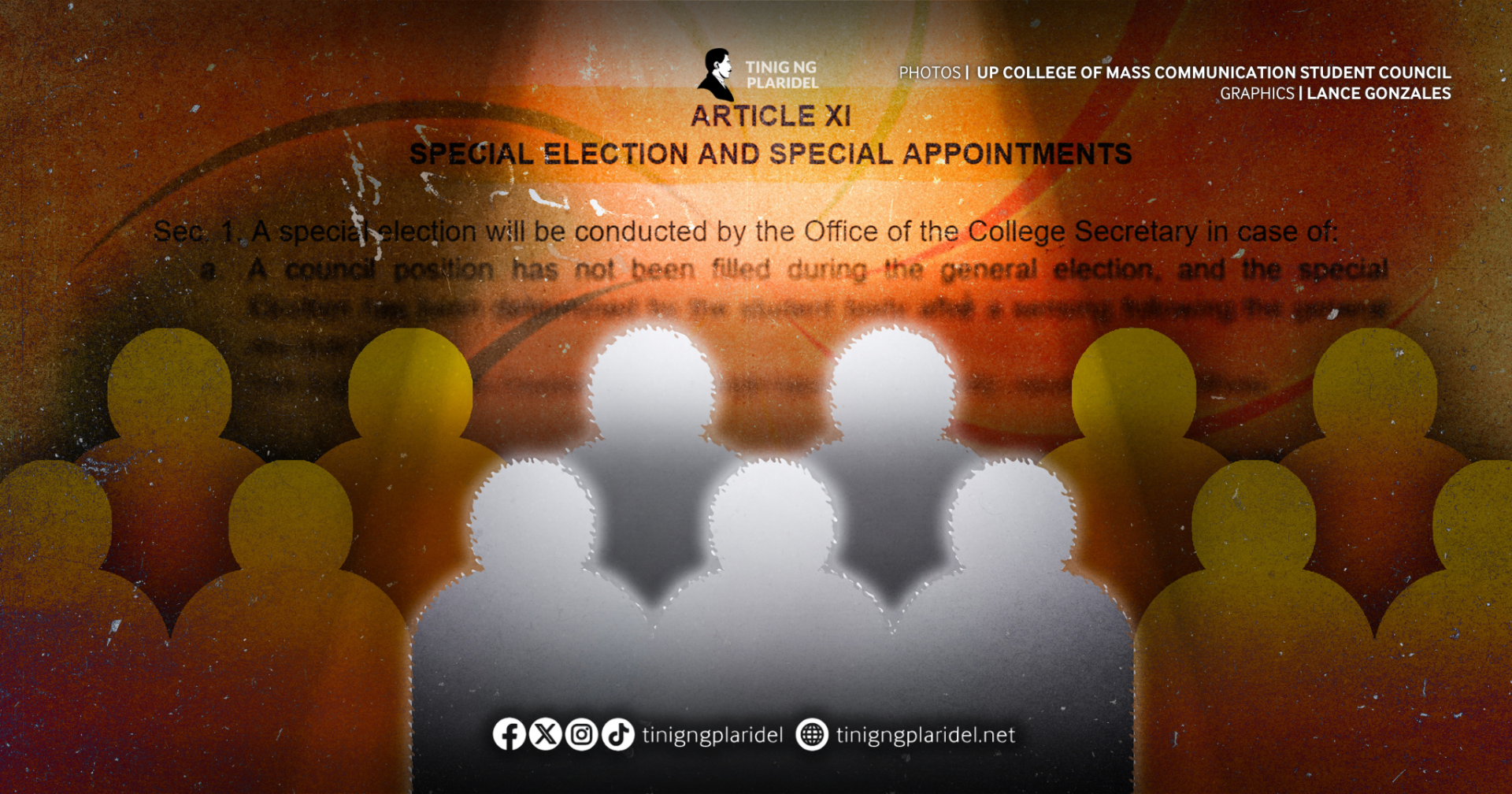
The proposed charter outlines clearer guidelines on holding either special elections or special appointments to fill permanent vacant posts, which will be subject to the preferred process by a majority vote of the Maskom student body.
Special elections will follow the same guidelines as general elections. If the majority of the student body votes for appointment over special elections, the Council of Representatives (COR) shall lead the interview and deliberation process among the appointees, subject to the approval of the college secretary.
“Ginawa namin ‘yong ganoong process para hindi na siya very bureaucratic process,” Quiapos told Tinig ng Plaridel. “In a sense, parang bibigyan pa rin ng power ‘yong student body to decide what process we should take after the regular elections.”
They said the proposed changes in the constitution have long been overdue to meet the current needs of the council and student body.
The 2014 charter lays out several mechanisms for filling permanent vacancies on the council.
A permanently vacant chairperson post is assumed by the vice chairperson. Permanent vacancies in other council positions are filled through an internal election among council members, the charter states.
For department representative seats, meanwhile, the constitution provides that vacancies be filled by the candidate who received the next highest number of votes in the previous election.
But the provision breaks down in practice.
Quiapos said the 2014 charter assumes there will be more than one candidate running for each position. In recent years, CMCSC candidates have been running unopposed. In some cases, certain seats have drawn no candidate at all.
READ: Vacancies remain in CMCSC amid independent slate win
Although the 2014 charter does not explicitly provide guidelines for a college-wide special election, CMCSC held one in 2024 by following the University Student Council’s special election process to fill vacant seats in the council, Quiapos said.
But even after the special election, CMCSC was left to grapple with vacancies in the treasurer post and in two film and one journalism representative seats that year.
READ: BMAS representation returns to CMC SC, vacancies remain
The incumbent CMCSC has five unfilled positions: secretary, treasurer, two film representatives, and one communication research representative.
READ: Advance CMC sweeps CMC SC seats
Providing guidelines for the conduct of either special elections or appointments is needed to “democratize the power of the student body to vote for their leaders,” Quiapos said.
“Vina-value natin ‘yong power ng CMCSC as an institution at bilang representante ng CMC students, ng constituents, na maging independent sa pagpili ng kanilang leader without the actual university dependency sa special elections.”
Among other proposed amendments in the CMCSC’s constitution are the following:
- To officially recognize the UP CMCSC as the UP College of Media and Communication Student Council.
- To rename the COR to Lider Kongreso sa Maskom (LEADKOM) and “realigning its purpose to the college.”
- To shorten the recommendation for amending the constitution from five years to three years.
- To remove the provision of the Constitution’s immediate effectivity only after the notification of the Board of Regents (BOR), the highest decision-making body of the UP System. The council deemed its constitution a non-issue of BOR’s meetings, and removing such provision “legitimizes the power of the student body” as the constitution would be effective immediately after a successful ratification.
“I think it’s time as well for the student council to apply these changes as, you know, ang trajectory ng kolehiyo natin nag-iiba rin when it comes to academics, pedagogy,” Quiapos said. “So I think it’s high time din for the student leadership, ‘yong provisions sa student council ng CMC will change as well.”
As of writing, the ratification form is open for the student body via online measures on the CMCSC’s Facebook page. An affirmative vote of 50% +1 of the CMC student body is required to ratify the constitution, in accordance with the 2014 charter.
Over three months since its launch, the ratification still needs around 135 more votes for enactment, said Quiapos.
“The ratification deadline will be loose. We won’t set a deadline, but rather, we [aim] to reach the 50+1% votes for it to be approved,” they added.
EDITOR’S NOTE: Tinig ng Plaridel is part of the CMC Council of Representatives (COR), which is proposed to be renamed as the Lider Kongreso sa Maskom (LEADKOM). However, the publication is excluded from all meetings and proceedings concerning the ratification process.