The Commission on Human Rights (CHR) made a last-ditch appeal to lawmakers to finance long-unfunded human rights laws as the bicameral conference committee convenes Saturday to settle differences between the House and Senate’s versions of the 2026 national budget.
CHR has faced difficulties implementing key rights laws due to funding deficits, an issue expected to persist as the government has proposed allotting the commission only half of its original budget proposal for 2026.
The commission initially asked the Department of Budget and Management for a P2.19-billion budget, but was allocated only P1.24 billion under the 2026 National Expenditure Program. The House-approved 2026 General Appropriations Bill (GAB) boosted the commission’s budget by only P50 million.
“Previous CHR budget enjoys Congress insertions for implementation of specific laws […] We hope the CHR budget might still be increased pursuant to our […] list of programs that needed financial resources,” Atty. Gemma Parojinog, director of CHR’s human rights policy advisory office, told Tinig ng Plaridel via phone interview Thursday.
These unfunded programs include 14 human rights laws CHR is otherwise mandated to enforce, based on data obtained by TNP from the commission.
According to Parojinog, budget gaps strain CHR’s capacity to hire investigators and extend financial and legal assistance to human rights victims, among others.
“CHR ang isa sa mga may pinakamababang budget. So sa lahat ng investigation cases namin, makikihati talaga lahat ng kaso,” she said.
Among the unfinanced laws is Republic Act (RA) No. 10353 or the Anti-Enforced or Involuntary Disappearance Act of 2012.
Nearing 14 years since its passage, RA 10353 has yet to be dedicated a specific line item budget in the CHR’s allocations under the 2026 GAB. This lack of funding comes despite the law mandating allocation for implementation by CHR.
Also unfunded is RA 9745 or the Anti-Torture Act of 2009, which criminalizes torture and inhumane treatment. The law’s enactment 16 years ago was lauded following challenges faced by survivors of torture in seeking justice against human rights violators.
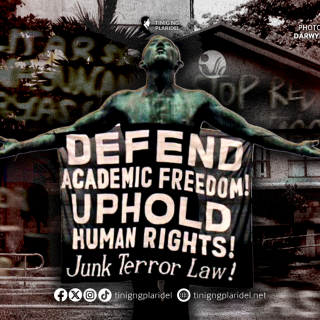
CHR’s mandate of investigating rights violations committed under RA 11479 or the Anti-Terrorism Act of 2020 is likewise imperiled by the commission’s lack of funds. RA 11479, which critics say vaguely defines terrorism, has been routinely weaponized by state forces to attack human rights defenders.
“If we were given budget, we could have formulated a more focused investigation on violations of civil and political rights pursuant to implementation of [the Anti-Terrorism Act],” Parojinog said.
Other unfunded rights laws include legislation promoting mental health and protecting the rights of children, women, queers, persons with disabilities and trafficked individuals, specifically:
- RA 11036 (Mental Health Act)
- RA 11188 (Special Protection of Children in Situations of Armed Conflict Act)
- RA 9344 (Juvenile Justice and Welfare Act)
- RA 11596 (An Act Prohibiting the Practice of Child Marriage and Imposing Penalties for Violations Thereof)
- RA 9262 (Anti-Violence Against Women and Their Children Act)
- RA 11210 (105-Day Maternity Leave Law)
- RA 9710 (Magna Carta of Women)
- RA 11166 (Philippine HIV and AIDS Policy Act)
- RA 11106 (Filipino Sign Language Act)
- RA 9208, as amended by RA 10364 and RA 11862 (Expanded Anti-Trafficking in Persons Act)
- RA 9851 (Philippine Act on Crimes Against International Humanitarian Law, Genocide, and Other Crimes Against Humanity)
Desperate measures
In the absence of specific line item funds for such laws, CHR resorts to lobbying for allocation increases during budget deliberations in Congress. When hit with a dead-end, the commission tries to maximize its limited agency budget to implement the laws, Parojinog said.
“We just make do with what we have, unfortunately. And then, tina-try namin ma-investigate [at] ma-implement as much as we can do with the resources,” the director said.
“‘Yong expected output mo, hindi talaga mari-reach ang potential kasi wala ngang budget allocation,” she added.
CHR reports the budget gaps to international human rights institutions to alarm the government about its funding woes, Parojinog said.
“Doon lang nagkakaroon ng leverage for other international instruments to tap on the priorities of government to promote human rights,” she said.
At the national level, Parojinog added CHR consults with other government agencies to raise issues with implementing unfunded laws, such as the Department of Justice and the Department of Social Welfare and Development.
“Because of that, nama-maximize ‘yong focus ng mga agency on how to properly implement the laws kasi you give them platform to discuss ‘yong mga gaps in the implementation,” she said.
Lost to corruption
Following the side-by-side observance of International Anti-Corruption Day on Tuesday and International Human Rights Day on Wednesday, Parojinog said unfunded human rights laws should not be discussed alone but addressed alongside widespread government corruption.
“Corruption is one of the biggest, most insidious human rights violations kasi you wouldn’t know that it actually affects your rights to so many things. ‘Yong security mo. Your access to classrooms. Your access to health, Nawawala ‘yon because of so many infrastructure projects that are getting corrupted,” Parojinog said.
According to Senate President Pro Tempore Ping Lacson, the Philippines may have lost as much as P180 billion in flood control funds alone since 2016. Climate justice group Greenpeace Philippines estimated this number may be as high as P1.1 trillion with all climate-tagged government projects considered.
“Kahit anong estado mo, bata ka o matanda ka, lahat very affected ‘pag may korapsyon sa gobyerno. So hindi dapat tayo complacent. Kailangan united tayo sa usapin ng korapsyon,” she said.
Editor’s note: The original version of this article was published by LAYA, a student publication under the Newsroom (J 121) class of Alcuin Papa.